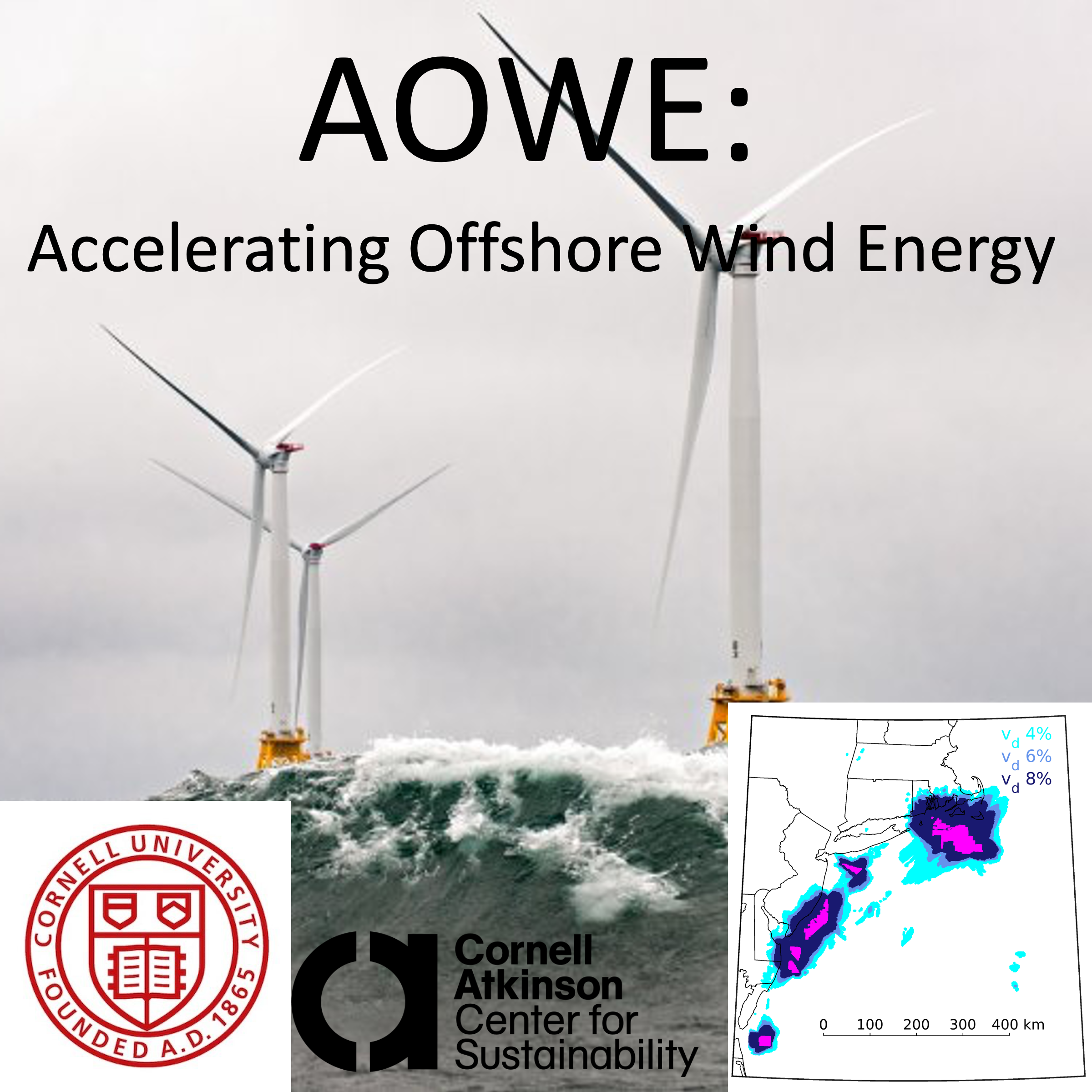
AOWE: Accelerating Offshore Wind EnergyPIs: Professor Sara C. Pryor (Earth and Atmospheric Sciences, EAS), Professor Rebecca J. Barthelmie (Sibley School of Mechanical and Aerospace Engineering,MAE), Professor Lindsey Anderson (BEE), Dr. Bruce Munger (EAS), and Assistant Professor Haji (MAE).
 /TBA
/TBA
|
Content
Overview
The move to reduce energy-related greenhouse gas emissions is gathering international momentum fueled by both the urgent need to reduce anthropogenic forcing of climate and rapid declines in the cost of renewable generation sources. In March 2021, the White House made a commitment to deploy 30 GW of offshore wind as part of a move to reduce U.S. greenhouse gas emissions by 50% from 2005 levels in 2030 and a carbon pollution-free power sector by 2035 (see White House briefing at; https://www.whitehouse.gov/briefing-room/). The United Kingdom government has committed to deploy 40 GW of offshore wind, sufficient to power every home in the United Kingdom by 2030. The European Commission’s Long-Term Strategy to decarbonization assumes 400 to 450 GW of installed offshore wind capacity within European waters by 2050. China has also committed to increasing the installed capacity of wind and solar power to over 1200 GW by 2030 from 414 GW in 2019. This unprecedented and rapid expansion of global offshore wind energy deployments affords opportunities to accelerate energy system transitions and reduce anthropogenic climate forcing. It also raises challenges in terms of how to optimally locate wind turbines offshore at the scale required to achieve electricity generation goals. This proposal is designed to provide timely and critical tools and information to guide growth of both U.S. and global offshore wind energy deployments.
Research progress/meetings/Advisory board
Publications
Presentations
Core Team
Related readings
Back to top