An integrated approach to offshore wind energy assessment (AIATOWEA): Experiment 2: NREL (lidar operation in complex terrain). |
|
Overview
Objectives
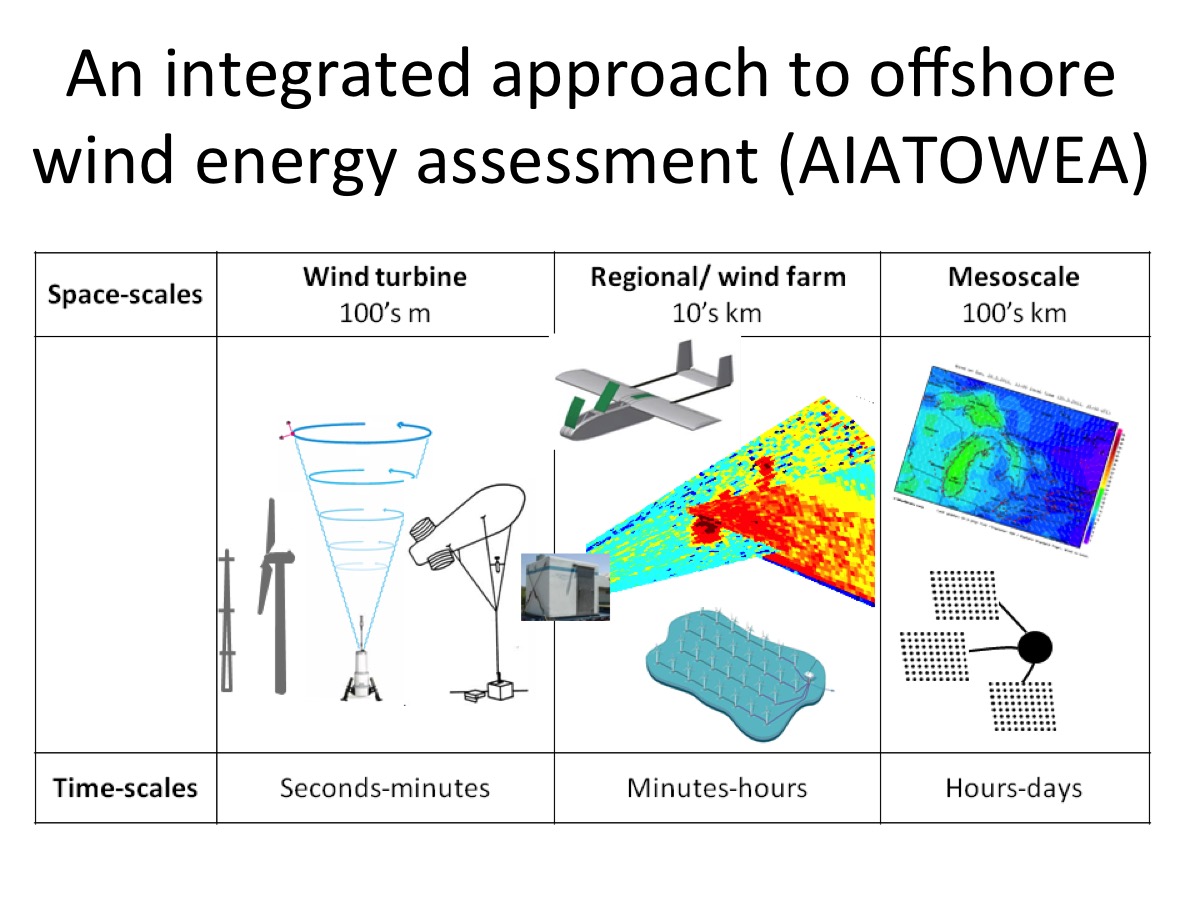
Introduction of new measurement technologies (including lidar) requires careful performance assessment (accuracy, reliability and precision), robust uncertainty quantification and development of normative guidance (e.g. IEC 61400-12-1 protocols). It further requires development of expertise in the operation of lidar and analysis and processing of the resulting data. Some kinds of lidar are already in standard use, but use of remote sensing technologies to provide high-quality observations of relevant flow parameters in inhomogeneous terrain and/or complex forested terrain is not straightforward. There are a number of challenges to application of lidars to characterising flow in complex environments. Notable among these is that the lidar sampled volume may be inhomogeneous. For scanning lidar there are two additional challenges: (i) difficulty in translating radial or line of sight wind speeds to the horizontal and vertical components of flow, and (ii) under-sampling of a rapidly varying flow field. Each data point comprises an average of many laser returns within a 3-second interval but each point in space is associated with a different time, and each point in space is sampled relatively infrequently. Thus there is a need to optimise scanning strategies to quantify and minimise the uncertainty in derived flow parameters. The focus of the second experiment was operation of the scanning lidar in complex terrain and performance characterization with sonic anemometers operated at the National Renewable Energy Laboratory in Colorado.
Major results
Our analyses demonstrated that for wind speeds up to 18 ms-1, the slope of a regression line between 10-minute mean wind speeds retrieved from a single 30° arc scan with the scanning lidar and those from a sonic anemometer was 1.033 and that the lidar estimates exhibited a root mean square error of 0.72 ms-1. This research was key to subsequent research in terms of defining efficient and effective scanning patterns for scanning doppler lidar (Wang et al. 2015) and developing tools to quantify the uncertainty in its operation (Wang et al. 2016a).
Journal Publications
Data
The dataset for this experiment is complex and too large to be hosted on a Cornell faculty members website due to space limitations. However, we will be happy to provide data on request. Please note the following caveats: Naturally we can not disclose data collected by NREL - please contact Andy Clifton for access to those data