Overview
The objective of this project is to develop a hierarchical model evaluation framework to allow for deeper diagnostic evaluation of numerical and statistical simulations of key climate features. The framework is informed by different uses of climate models and climate model outputs by climate scientists and stakeholders for planning and managing resources. It features a cascade of metrics including standard descriptive metrics (e.g. statistical skill scores), new climatological and ingredients-based quality metrics, new phenomena-based metrics for specific event types, and integrated regional metrics that combine the above metrics for specific regions. Metrics specifically tailored for the Energy-Water-Land (E-W-L) nexus will inform strategies for modeling human-Earth system dynamics at regional scales.
Cornell University foci and contributions
Empirical statistical downscaling within FACETS
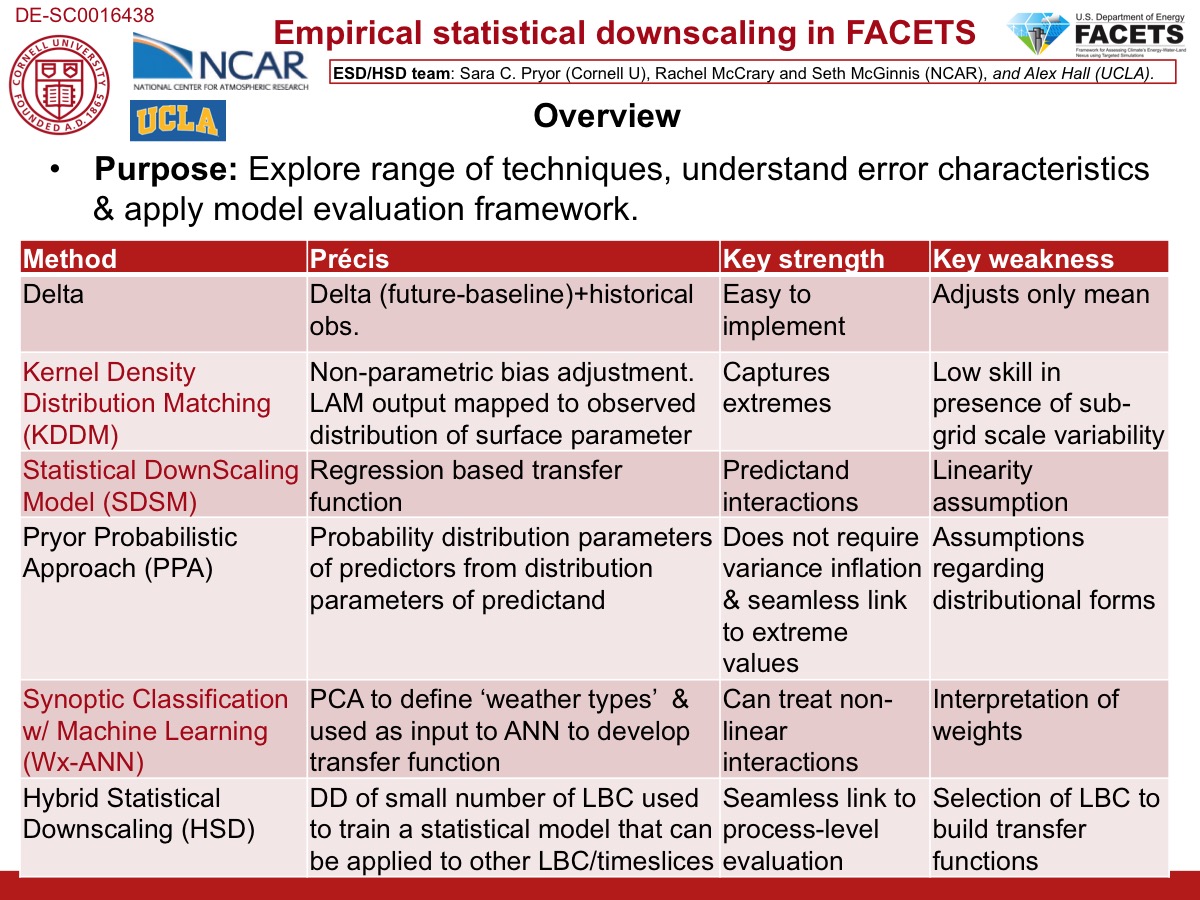
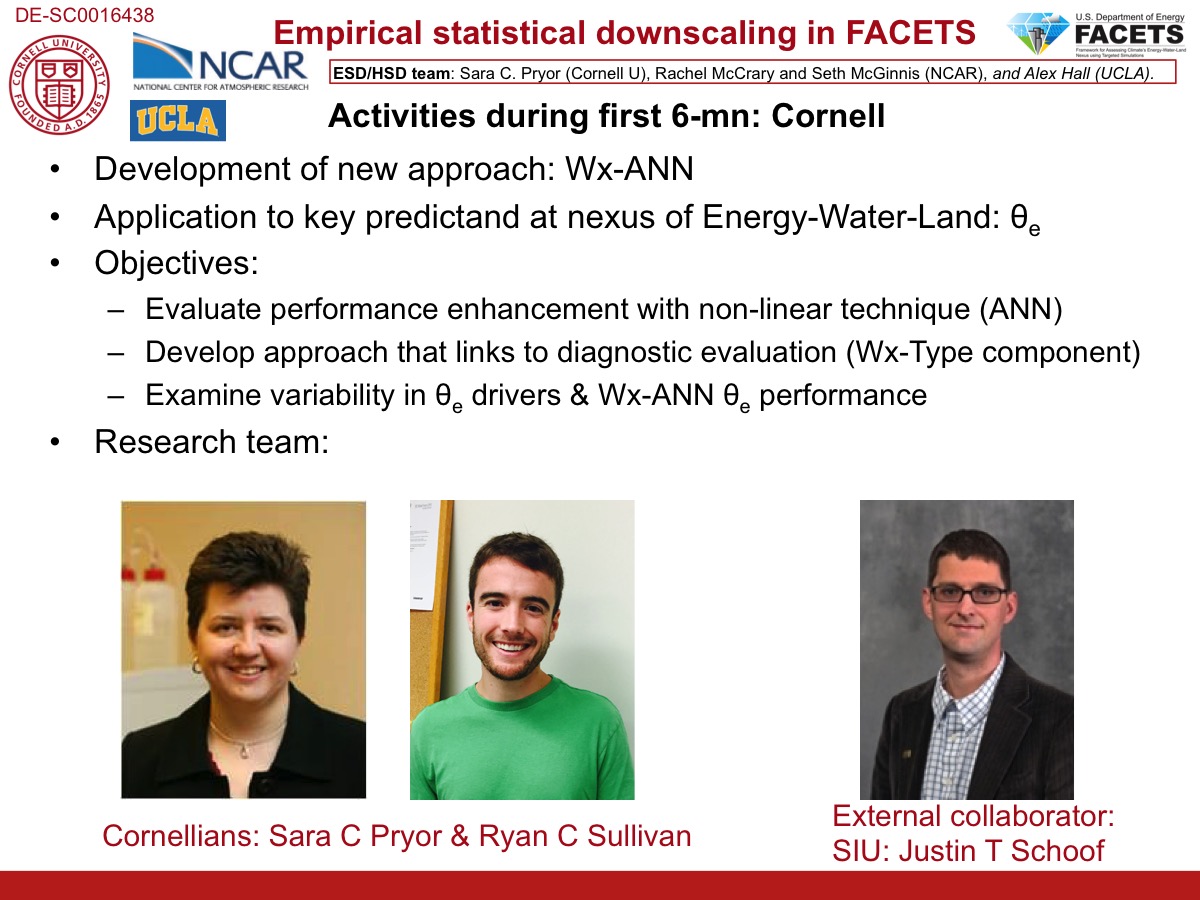
Professor Pryor is leading a workpackage within FACETS that is focussed on Empirical and hybrid downscaling. The schematic shows the range of approaches we, and our colleagues from NCAR and UCLA, are using (left). A key innovative aspect of our approach is (consistent with the hierarchical framework of the project) that we are using a hierarchy of approaches - some are relatively straightforward (e.g. Delta) and while they have been widely applied they are known to suffer from a number of limitations. Other approaches are more sophisticated (but still mainstream) - e.g. SDSM. While others are predicated on slightly more sophisticated statistical tools (e.g. Wx-ANN) and others are advanced combinations of dynamical and statistical approaches (HSD). Using this suite we can both evaluate relative performance and also use the statistical approaches to diagnose dynamical models. As just one example the Wx-ANN approach we have developed within this project at Cornell can be used to evaluate the synoptic-scale circulation conditions from RCM/other models by first applying our synoptic classification procedure to an 'observed' reanalysis data set and then either allowing a free classification from the RCM/MPAS OR targeting that from the reanalysis. The image on the right below shows the Cornell 'team' working on ESD with the project and describes our foci during this first 6-months of the project; (i) development of the new Wx-ANN approach and (ii) application of that framework to assess a key variable right at the intersection of the E-W-L nexus - equivalent potential temperature.
Dynamical downscaling and human dimensions of change within FACETS
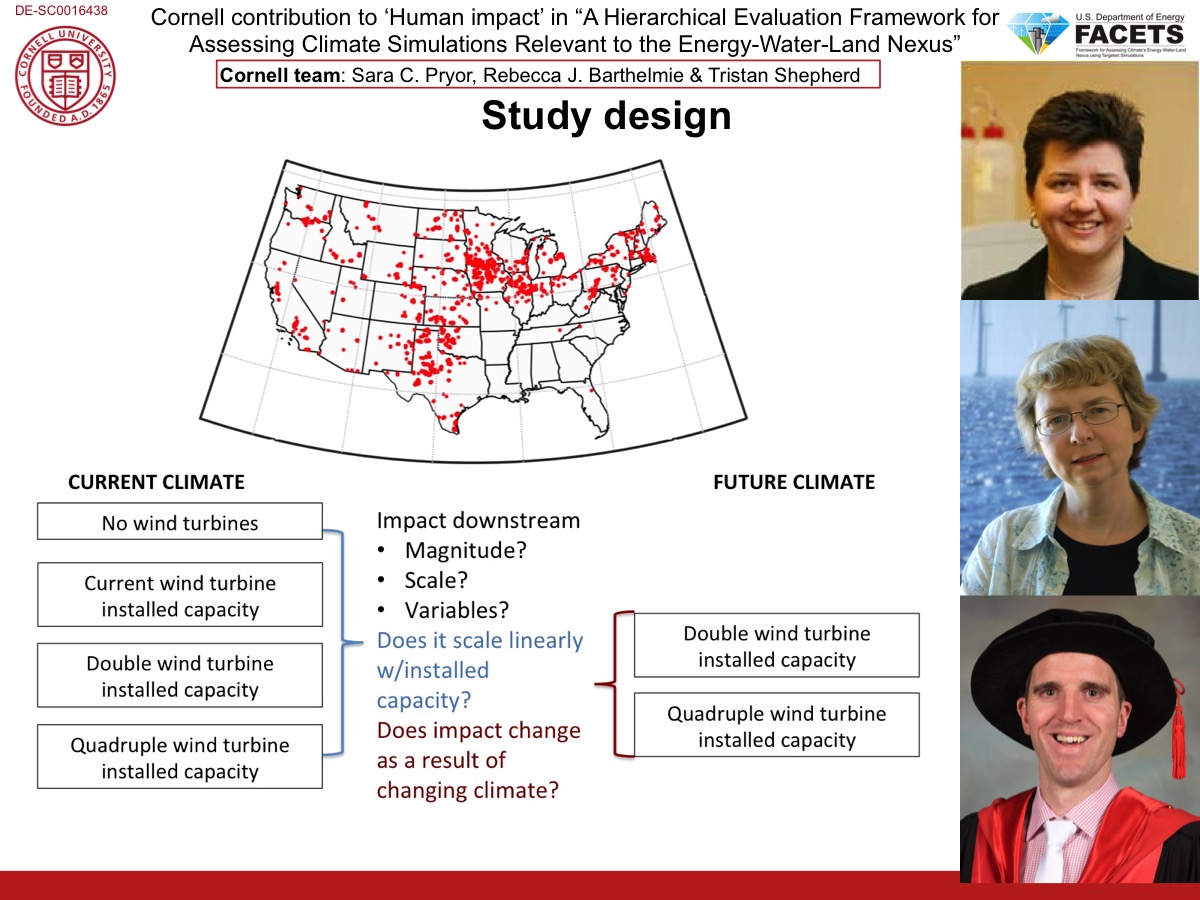
Professors Pryor and Barthelmie along with Dr. Tristan Shepherd are working on a key component of FACETS - understanding the reciprocal relationships between non-stationary climate conditions and their potential impact (positive or negative) on a key component of decarbonizing the electricity supply system (wind power plants) and the impact of large-scale wind turbine deployments (if any!) on the local/regional climate system (see below left for the team and our study design).
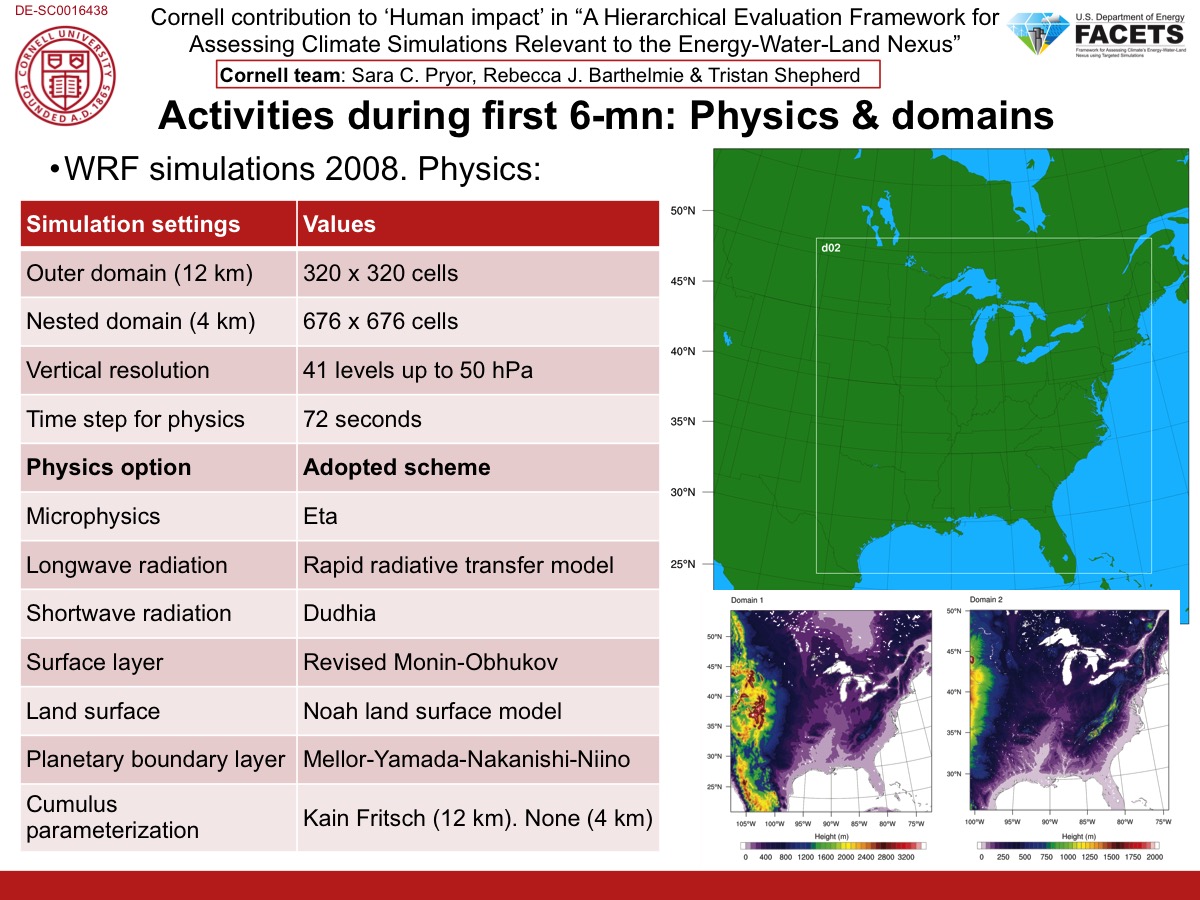
Naturally all components of the energy system cause some modification of the atmosphere - whether it be via emission of so-called greenhouse gases, or in the case of the wind turbines reduction of wind speeds in the lee of wind turbines (because the turbines work by extracting kinetic energy from the wind and converting that into electricity). We have previously conducted empirical research to assess this effect and found it to be of very small magnitude at distances of a few hundred meters downstream of a major wind turbine power plant. That research was published in: Smith C.M., Barthelmie R.J and Pryor S.C. (2013): In-situ observations of the influence of a large onshore wind farm on near-surface temperature, turbulence intensity and wind speed profiles. Environmental Research Letters 8(3) 034006 doi:10.1088/1748-9326/8/3/034006. Our simulation domain (we are using WRF as the numerical model, consistent with the use of this model in the dynamical downscaling WP) and details of the simulations are given below (right).
Videos of our simulations
We are conducting very high resolution simulations with WRF (12 km nested to 4 km). Here is a very short example of 10-m wind speeds from the inner domain.
Publications
Published
Pryor S.C., Letson F.W. and Barthelmie R.J. (2020): Variability in wind energy generation across the contiguous USA. Journal of Applied Meteorology and Climatology 59 2021-2039.
Aird J.A., Barthelmie R.J., Shepherd T.J. and Pryor S.C.: WRF-simulated Low-Level Jets over Iowa: Characterization and sensitivity studies. Wind Energy Science Discussion https://doi.org/10.5194/wes-2020-113 .
Pryor S.C., Barthelmie R.J., Bukovsky M.S., Leung L.R. and Sakaguchi K. (2020): Climate change impacts on wind power generation. Nature Reviews: Earth and Environment 1 627-643 doi: 10.1038/s43017-020-0101-7.
Letson F., Shepherd T.J., Barthelmie R.J. and Pryor S.C. (2020): WRF Modelling of Deep Convection and Hail for Wind Power Applications. Journal of Applied Meteorology and Climatology 59 1717–1733
Pryor S.C. and Schoof J.T. (2020): Differential credibility assessment for statistical downscaling. Journal of Applied Meteorology and Climatology 59 1333-1349.
Barthelmie R.J., Shepherd T.J., Aird J.A. and Pryor S.C. (2020): Power and wind shear implications of large wind turbine scenarios in the U.S. Central Plains. Energies 13(16) 4269 https://doi.org/10.3390/en13164269 .
Pryor S.C., Shepherd T., Volker P., Hahmann A., and Barthelmie R.J. (2020): Diagnosing systematic differences in predicted wind turbine array-array interactions. Journal of Physics: Conference Series 1618 062023 doi:10.1088/1742-6596/1618/6/062023 .
Aird J., Barthelmie R.J., †Shepherd T.J. and Pryor S.C. (2020): WRF-simulated springtime low-level jets over Iowa: Implications for wind energy. Journal of Physics: Conference Series 1618 062020 doi:10.1088/1742-6596/1618/6/062020 .
Barthelmie R.J., Shepherd T.J. and Pryor S.C. (2020): Increasing turbine dimensions: Impact on shear and power. Journal of Physics: Conference Series 1618 062024 doi:10.1088/1742-6596/1618/6/062024 .
Letson F., Barthelmie R.J. and Pryor S.C. (2020): Sub-regional variability in wind turbine blade leading-edge erosion potential. Journal of Physics: Conference Series 1618 032046 doi:10.1088/1742-6596/1618/3/032046 .
Gutowski Jr W.J., Hall A., Leung L.R., O’Brien T., Patricola C., Ullrich P., Arritt R., Bukovsky M., Calvin K.V., Feng Z., Jones A.D., Kooperman G.J., Monier E., Pritchard M.S., Pryor S.C., Qian Y., Rhoades A.M., Roberts A.F., Sakaguchi K., Urban N., Zrarzycki C. (2020): The ongoing need for high-resolution regional climate models: Process understanding and stakeholder information. Bulletin of the American Meteorological Society. 101 (5): E664–E683.
Chen L., Zhang R., Pryor S.C., Li X. and Wang H. (2020): Coupling of Wintertime Surface Sensible Heat Flux Variability over the Central and Eastern Tibetan Plateau to the East Asian Winter Monsoon. Climate Dynamics, 54 4589-4603.
Shepherd T.J., Barthelmie R.J. and Pryor S.C. (2020): Sensitivity of wind turbine array downstream effects to the parameterization used in WRF. Journal of Applied Meteorology and Climatology, 59 333-361.
Letson F.W., Barthelmie R.J., and Pryor S.C. (2020): RADAR-derived precipitation climatology for wind turbine blade leading edge erosion. Wind Energy Science 5 331-347 https://www.wind-energ-sci.net/5/331/2020/wes-5-331-2020.pdf
Pryor S.C., Shepherd T.J. and Barthelmie R.J. (2020): 20% of US electricity from wind: Impacts on system efficiency and regional climate. Scientific Reports 10 art # 541 doi: 10.1038/s41598-019-57371-1.
Pryor S.C., Shepherd T.J., Volker P., Hahmann A.N. and Barthelmie R.J. (2020): ‘Wind theft’ from onshore wind turbine arrays: Sensitivity to wind farm parameterization and resolution. Journal of Applied Meteorology and Climatology, 59 153-174.
Pryor S.C., Shepherd T.J., Bukovsky M. and Barthelmie R.J. (2020): Assessing the stability of wind resource and operating conditions. Journal of Physics: Conference Series 1452 012084 doi: 10.1088/1742-6596/1452/1/012084 .
Barthelmie R.J., Letson F., Ahsan S.N., Barbaria D.K., Barrera C.S., Creaer A., Dudley LCC, Garell M., La Spisa E.J., Li S., Mishr A., Paranjape A.R., Rambaran S., Singh A., Hu W. and Pryor S.C (2020): Wind turbine blade leading-edge erosion Journal of Physics: Conference Series 1452 012046 doi: 10.1088/1742-6596/1452/1/012046 .
Letson F., Shepherd T.J., Barthelmie R.J. and Pryor S.C. (2020): Modelling hail and convective storms with WRF for wind energy applications. Journal of Physics: Conference Series 1452 012051 doi: 10.1088/1742-6596/1452/1/012051 .
Li S., Barthelmie R.J., Bewley G.P. and Pryor S.C. (2020): Effects of hydrometeor droplet characteristics on wind turbine blade leading edge erosion: a numerical study. Journal of Physics: Conference Series 1452 012053 doi: 10.1088/1742-6596/1452/1/012053 .
Pryor S.C., Shepherd T.J., Barthelmie R.J., Hahmann A., Volker P. (2019): Wind farm wakes simulated using WRF. Journal of Physics: Conference Series 1256 012025 , doi: 10.1088/1742-6596/1256/1/012025
Chen L., Pryor S.C., Wang H. and Zhang R. (2019): Distribution and variation of the surface sensible heat flux over the central and eastern Tibetan Plateau: Comparison of station observations and multi-reanalysis products. Journal of Geophysical Research: Atmospheres 124 6191-6206.
Schoof J.T., Pryor S.C., and Ford T. (2019): Projected changes in United States regional extreme heat days derived from bivariate quantile mapping of CMIP5 simulations. Journal of Geophysical Research: Atmospheres 134 doi: 10.1029/2018JD029599.
Pryor S.C. and Schoof J.T. (2019): A hierarchical analysis of the impact of methodological decisions on statistical downscaling of daily precipitation and air temperatures. International Journal of Climatology. International Journal of Climatology 39 2880-2900
Letson, F., Barthelmie, R. J., Hu, W., and Pryor, S. C. (2019): Characterizing wind gusts in complex terrain, Atmos. Chem. Phys., 19, 3797-3819. https://doi.org/10.5194/acp-19-3797-2019
Pryor S.C. and Hahmann A.N. (2019): Downscaling wind. In Oxford Research Encyclopedia of Climate Science. Oxford University Press. doi: http://dx.doi.org/10.1093/acrefore/9780190228620.013.730
Barthelmie R.J. and Pryor S.C. (2018): The impact of wind direction yaw angle on cliff flows. Wind Energy 21 1254-1265.
Pryor S.C., Shepherd T.J. and Barthelmie R.J. (2018): Inter-annual variability of wind climates and wind turbine annual energy production. Wind Energy Science 3 651-665. Download it here.
Pryor S.C., Barthelmie R.J., Hahmann A., Shepherd T.J., Volker P. (2018): Downstream effects from contemporary wind turbine deployments. Journal of Physics: Conference Series 1037 072010 doi: 10.1088/1742-6596/1037/7/072010 Download it here.
Hu W., Letson F., Barthelmie R.J., and Pryor S.C. (2018): Wind gust characterization at wind turbine relevant heights in moderately complex terrain. Journal of Applied Meteorology and Climatology 57 1459-1476.
Pryor S.C., Barthelmie R.J. and Shepherd T.J. (2018): The influence of real-world wind turbine deployments on regional climate. Journal of Geophysical Research: Atmospheres 123 5804-5826 (doi: 10.1029/2017JD028114).
Pryor S.C., Sullivan R.C. and Schoof J.T. (2017): Modeling the contributions of global air temperature, synoptic-scale phenomena and soil moisture to near-surface static energy variability using artificial neural networks. Atmospheric Chemistry and Physics 17, 14457-14471, Download it here.
Schoof J.T., Ford T. and Pryor S.C. (2017): Recent changes in United States heat wave characteristics derived from multiple reanalyses. Journal of Applied Meteorology and Climatology 56 2621-2636.
Presentations
Pryor S.C., Shepherd T., Volker P., Hahmann A., and Barthelmie R.J. (2020): Diagnosing systematic differences in predicted wind turbine array-array interactions. The Science of Making Torque from Wind. University of Delft, Delft, The Netherlands, May 2020.
Aird J., Barthelmie R.J., Shpeherd T.J. and Pryor S.C. (2020): WRF-simulated springtime low-level jets over Iowa: Implications for wind energy. The Science of Making Torque from Wind. University of Delft, Delft, The Netherlands, May 2020.
Barthelmie R.J., Shepherd T.J. and Pryor S.C. (2020): Increasing turbine dimensions: Impact on shear and power. The Science of Making Torque from Wind. University of Delft, Delft, The Netherlands, May 2020.
Letson F., Barthelmie R.J. and Pryor S.C. (2020): Sub-regional variability in wind turbine blade leading-edge erosion potential. The Science of Making Torque from Wind. University of Delft, Delft, The Netherlands, May 2020.
Barthelmie R.J., Letson F. and Pryor S.C. (2020): Hail as a major damage vector for wind turbine blades. 3rd European Hail Workshop, Karlsruhe, Germany March 2020.
Pryor S.C., Shepherd T.J., Letson F. and Barthelmie R.J. (2020): Modeling hail using WRF. 3rd European Hail Workshop, Karlsruhe, Germany, March 2020.
Pryor, S.C. (2020): Use of dual-polarization RADAR and WRF to characterize blade leading edge erosion potential. International Symposium on Leading Edge Erosion of Wind Turbine Blades, Danish Technical University, Roskilde, Denmark, February 2020. (Invited)
Barthelmie R.J. 2020: Experimental investigations of blade leading edge erosion potential. International Symposium on Leading Edge Erosion of Wind Turbine Blades, Danish Technical University, Roskilde, Denmark, February 2020. (Invited)
Pryor S.C., Letson F., Shepherd T. and Barthelmie R.J. (2020): Use of dual-polarization RADAR and WRF to characterize blade leading edge erosion potential. IEA Wind Task 11 Topical Expert Meeting # 98 On Erosion Of Wind Turbine Blades, Danish Technical University, Roskilde, Denmark, February 2020.
Barthelmie R.J. et al. (2020): Experimental investigations of blade leading edge erosion potential. IEA Wind Task 11 Topical Expert Meeting # 98 On Erosion Of Wind Turbine Blades, Danish Technical University, Roskilde, Denmark, February 2020.
Pryor S.C., Shepherd T.J., Bukovsky M. and Barthelmie R.J. (2019): Assessing the stability of wind resource and operating conditions. North American Wind Energy Academy WindTech Conference, Amherst, USA, October 2019 (oral pme="Publications">resentation).
Barthelmie R.J., Letson F., Ahsan S.N., Barbaria D.K., Barrera C.S., Creaer A., Dudley LCC, Garell M., La Spisa E.J., Li S., Mishr A., Paranjape A.R., Rambaran S., Singh A., Hu W. and Pryor S.C (2019): Wind turbine blade leading-edge erosion. North American Wind Energy Academy WindTech Conference, Amherst, USA, October 2019 (oral presentation).
Letson F., Shepherd T.J., Barthelmie R.J. and Pryor S.C. (2019): Modelling hail and convective storms with WRF for wind energy applications. North American Wind Energy Academy WindTech Conference, Amherst, USA, October 2019 (oral presentation).
Letson F., Barthelmie R.J. and Pryor S.C. (2019): Wind turbine blade leading edge erosion from hail: A case study in Texas. North American Wind Energy Academy WindTech Conference, Amherst, USA, October 2019 (poster presentation).
Hu W., Wang X., Wang Y., Lui Z., Tan R., Letson F., Pryor S.C. and Barthelmie R.J. (2019): A computational model of wind turbine blade erosion induced by raindrops impact. North American Wind Energy Academy WindTech Conference, Amherst, USA, October 2019 (oral presentation).
Li S., Barthelmie R.J., Bewley G.P. and Pryor S.C. (2019): Effects of hydrometeor droplet characteristics on wind turbine blade leading edge erosion: a numerical study. North American Wind Energy Academy WindTech Conference, Amherst, USA, October 2019 (oral presentation).
Shepherd T.J., Barthelmie R.J. and Pryor S.C. (2019): Assessment of wind turbine impact on future climate in GCM-driven WRF simulations. North American Wind Energy Academy WindTech Conference, Amherst, USA, October 2019 (oral presentation).
Shepherd T.J., Barthelmie R.J. and Pryor S.C. (2019): Quantifying array-array effects using WRF model simulations: A sensitivity analysis. North American Wind Energy Academy WindTech Conference, Amherst, USA, October 2019 (poster presentation).
Pryor S.C., Shepherd T., Volker P., Hahmann A., and Barthelmie R.J. (2019): ‘Wind theft’ from onshore arrays: Sensitivity to wind farm parameterization and resolution. Wind Energy Science Conference 2019, Cork, Ireland, June 2019 (oral presentation).
Pryor S.C., Shepherd T., Barthelmie R.J., Hahmann A., and Volker P. (2019): Wind farm wakes simulated using WRF. Wakes Conference 2019, Visby, Sweden, May 2019 (oral presentation).
Pryor S.C., Shepherd T.J., Bukovsky M., and Barthelmie R.J. (2019): Wind energy scenarios for climate change mitigation. The Scenarios Forum 2019, Denver CO, April 2019 (oral)
Shepherd T.J., Brazier A., Wineholt B., Barthelmie R.J. and Pryor S.C. (2019): Quantifying weather and climate simulation reproducibility in the cloud. 99th American Meteorological Society Annual Meeting (Fifth Symposium on High Performance Computing for Weather, Water, and Climate), Phoenix, AZ, 6-10 January 2019.
Shepherd T.J., Volker P., Barthelmie R.J., Hahmann A., and Pryor S.C. (2019): Sensitivity of wind turbine array downstream effects to the parameterization used in WRF. 99th American Meteorological Society Annual Meeting (10th Conference on Weather, Climate, and the New Energy Economy), Phoenix, AZ, 6-10 January 2019.
Pryor S.C., Barthelmie R.J., Hahmann A., Shepherd T., and Volker P. (2018): Downstream effects from contemporary wind turbine deployments. Science of Making Torque from Wind, Milan Italy, June 2018 (oral presentation).
Shepherd, T.J., Volker P., Barthelmie R.J., Hahmann A., Pryor S.C. (2018): Sensitivity of wind turbine array downstream effects to the parameterization used in WRF WRF/MPAS User’s Workshop, Boulder, CO. June 2018 (oral presentation).
Pryor S.C., Barthelmie R.J. and Shepherd T. (2018): Do current and near-term future wind turbine deployments have a substantial impact on regional climate? European Geosciences Union General Assembly 2018, Vienna, Austria 8–13 April 2018 (Invited presentation).
Letson, F.W., Barthelmie R.J., Hu W., and Pryor S.C. (2018): Wind gusts in complex terrain: Analyses of data from Perdigao. European Geosciences Union General Assembly 2018, Vienna, Austria 8–13 April 2018 (PICO presentation).
Pryor S.C., Barthelmie R.J., Biondi T. and Shepherd T. (2018): Improved Characterization Of The Magnitude And Causes Of
Spatio-Temporal Variability In Wind Resources. 98th American Meteorological Society Annual Meeting
(31st Conference on Climate Variability and Change), Austin TX, January 2018.
Shepherd T., Barthelmie R.J. and Pryor S.C. (2018): Assessing the fidelity of the North American wind climate and impacts of wind farms using high resolution modeling. 98th American Meteorological Society Annual Meeting (21st Conference on Planned and Inadvertent Weather Modification), Austin TX, January 2018.
Pryor S.C., Barthelmie R.J. and Shepherd T. (2017): High-fidelity simulations of the downstream impacts of high density wind turbine deployments. 4th Workshop on Systems Engineering for Wind Energy, Roskilde, Denmark, September 2017 .
Data sets
WRF output from publication: Pryor S.C., Shepherd T.J. and Barthelmie R.J. (2018): Inter-annual variability of wind climates and wind turbine annual energy production. Wind Energy Science 3 651-665. Simulation purpose: Evaluate interannual variability in resource. Resolution: 12 km. Domain: Eastern North America. Available on ZENODO: 10.5281/zenodo.1257143.
WRF output from publication: Pryor S.C., Shepherd T.J., Volker P., Hahmann A.N. and Barthelmie R.J. (2020): ‘Wind theft’ from onshore wind turbine arrays: Sensitivity to wind farm parameterization and resolution. Journal of Applied Meteorology and Climatology 59 153-174. Simulation purpose: Evaluate wind turbine array wakes as a function of wind farm paramaterization used in WRF. Resolution: 4 km and 2 km with 2 vertical resolutions. Available on ZENODO: 10.5281/zenodo.3556723.
WRF output from publication: Pryor S.C., Barthelmie R.J. and †Shepherd T.J. (2020): 20% of US electricity from wind will have limited impacts on system efficiency and regional climate. Nature: Scientific Reports 10 541 doi:10.1038/s41598-019-57371-1. Simulation purpose: Simulations of wind turbine wakes conducted with WRF for current and possible future installed capacities upto 20% US electricity from wind. Resolution: 4 km. Available on ZENODO: 10.5281/zenodo.3595571.
WRF output from publication: Pryor S.C., Barthelmie R.J. and †Shepherd T.J. (2018): The influence of real-world wind turbine deployments on local to mesoscale climate. Journal of Geophysical Research: Atmospheres 123 5804-5826 (doi: 10.1029/2017JD028114). Simulation purpose: WRF wind turbine wakes: Output at 4 km resolution for ALL WRF variables for an entire year (i.e. the entire simulation output). The entire WRF model output generated within this project is available for download
at http://portal.nersc.gov/archive/home/projects/m2645/www/public_data_iowa/.
Team
Professor Sara C. Pryor, Earth and Atmospheric Sciences
Professor Rebecca J. Barthelmie, Mechanical and Aerospace Engineering
Dr. Tristan Sheperd, Post Doc, Earth and Atmospheric Sciences
Dr. Fred Letson, Post Doc, Earth and Atmospheric Sciences
Past member: Dr. Weifei Hu, who was a Post Doc and is now a faculty member at Zhejiang University
Past member: Dr. Ryan C. Sullivan, who was a Ph.D candidate and is now a scientist at Argonne Nat. Lab.
Past member:
Mr. Vernon (Ryan) Rippeon, Undergraduate student (funded to work on this project under an NSF REU grant focussed on use of HPC for scientific applications, summer 2019), Earth and Atmospheric Sciences
Past member:
Mr. Peter Cook, Undergraduate student (funded to work on this project under an NSF REU grant focussed on use of HPC for scientific applications, summer 2018), Earth and Atmospheric Sciences
Past member: Mr. Thomas Biondi, Undergraduate student (funded to work on this project under an NSF REU grant focussed on use of HPC for scientific applications, summer 2017), Earth and Atmospheric Sciences
Back to top