Cornell University contribution to the 2017 international field experiment in Perdigao, Portugal.The Cornell team is led by Professor Rebecca J. Barthelmie of the Sibley School of Mechanical and Aerospace Engineering and Professor Sara C. Pryor of the Department of Earth and Atmospheric Sciences. |

|
Overview
This experiment - which ran rom Jan. through end-June 2017 is focussed on improved understanding of flow in complex terrain. Our specific foci are; (i) Improved understanding of wind turbine wakes (generation, dissipation and translation in complex terrain). (ii) Evaluation of various lidar remote sensing technologies in complex terrain (we are using direct detection and doppler shift technologies, continuous wave and pulsed systems and scanning and vertically pointing lidar configurations). (iii) Wind gusts (coherence and spatial extent).
This experiment is part of the New European Wind Atlas project led by Professor Jakob Mann of DTU. The Cornell team is led by Professor Rebecca J. Barthelmie of the Sibley School of Mechanical and Aerospace Engineering and Professor Sara C. Pryor of Earth and Atmospheric Sciences. The US group includes members from NCAR, Army Research Lab., Cornell University, University of Notre Dame, Colorado U., Oklahoma U. and UCBerkley. Our (Cornell and many of the US partners) research is funded by the National Science Foundation (Cornell grant # 1565505). Please note that any opinions, findings, and conclusions or recommendations expressed in this material are those of the author(s) and do not necessarily reflect the views of the National Science Foundation. The Perdigao project was featured in a new article written by Alexandra Witze for the journal Nature in February 2017. The Nature News piece appeared in volume 542 p282-283. AND if that wasn't enough the project was featured in the Portugese newspaper 'Publico' and I (Sara) was quoted - what an honor! AND Professor Sara C Pryor discussed the project in a 1-minute TECH TALK on WHCU870 AM 95.9FM News TalkEquipment
Equipment deployed at Perdigao for the long term experiment (Jan-Jun 2017)Click here to watch a video from the SW ridge (near the location of the SpiDAR) showing the valley (and the Orange Grove site)
Click here to watch a video of the instruments at the Orange Grove site and a 360 deg view of the terrain around the site
Blog
Blog of the January 2017 installation: The purpose of this trip to Perdigao was to install the 4 lidar systems (1 Galion, 2 ZephIRs and 1 SpiDAR) and 3 seismometers, and to place those systems onto the wifi network.Blog of the February 2017 continuation of the installation: Due to some delays in the site preparedness, we returned to install the final lidar (1 SpiDAR) and 3 seismometers, and hoped to place those systems onto the wifi network.
Blog of the April 2017 visit: The purpose of this trip is to install our final piece of equipment a particle sizing instrument (TSI APS 3321), collect some ultra-high resolution output from the ZephIRs (by live streaming), collect data from the seismometers and hopefully conduct repairs on the SpiDAR - fingers crossed! (plus we might finally get to place the systems onto the wifi network).
Blog of the May 2017 visit: The purpose of this trip is to maintain our instruments and verify all is going to plan etc!
Blog of the Jun/Jul 2017 visit: The purpose of this trip is to terminate our measurements and ship our instruments back to Cornell
Data
Data access
Data collected by the Cornell team are available from two repositories: a Perdigao Long Term Archive web page hosted by NCAR: http://data.eol.ucar.edu/master_list/?project=PERDIGAO and also the official NEWA archive at the University of Porto: https://perdigao.fe.up.pt/. Here are the individual DOI for the Cornell datasets:Data 'quick looks' from our first measurements at Perdigao in January!
Here are some 'snap-shots' of data from the lidar systems: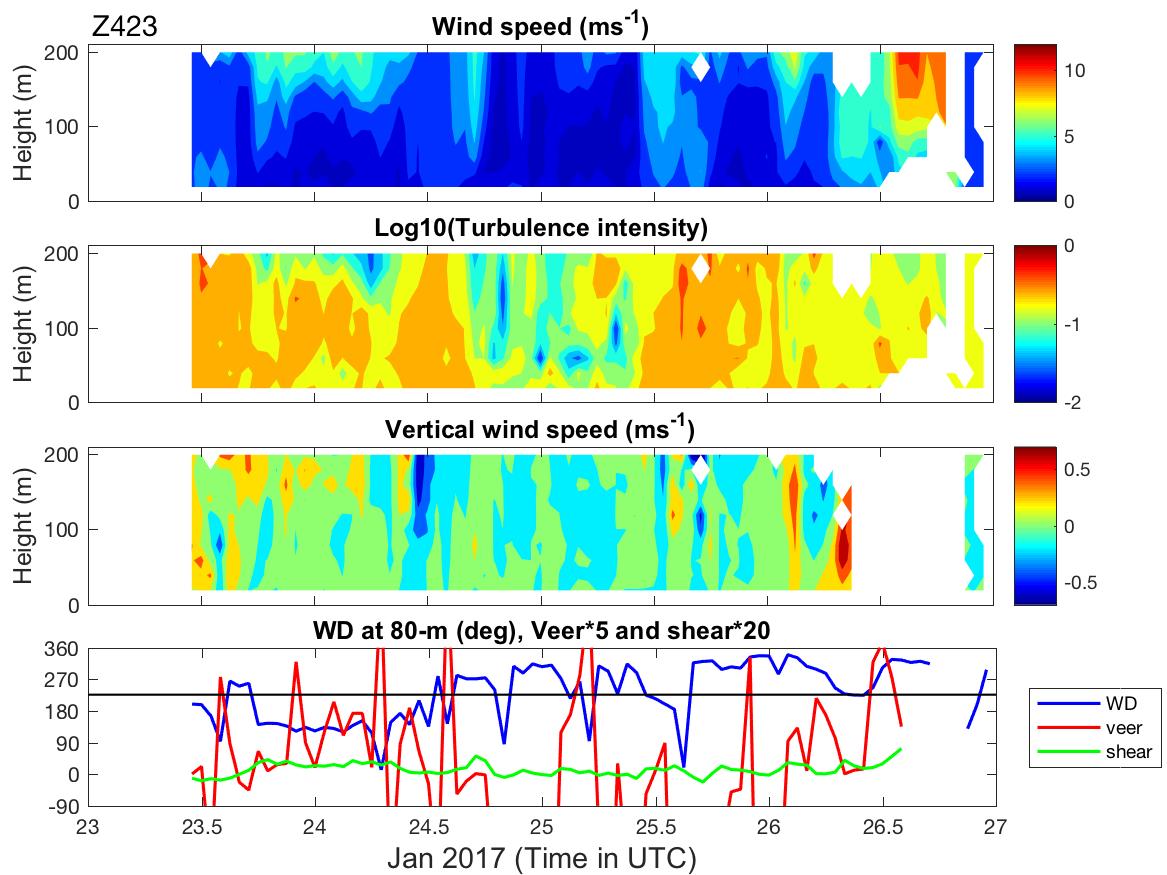 Initial data from ZephIR Z423 at the Orange Grove site in the valley
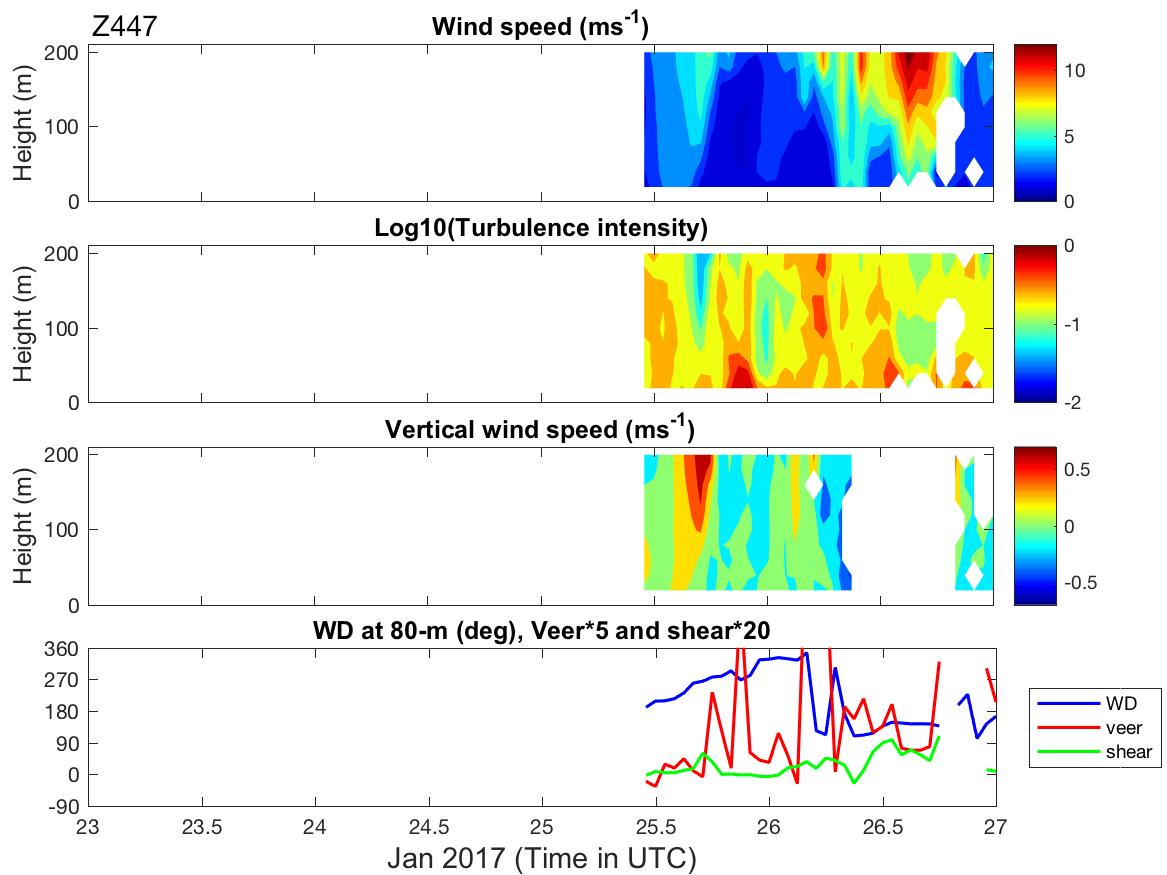 Initial data from ZephIR Z447 at the Olive Coop west of the valley
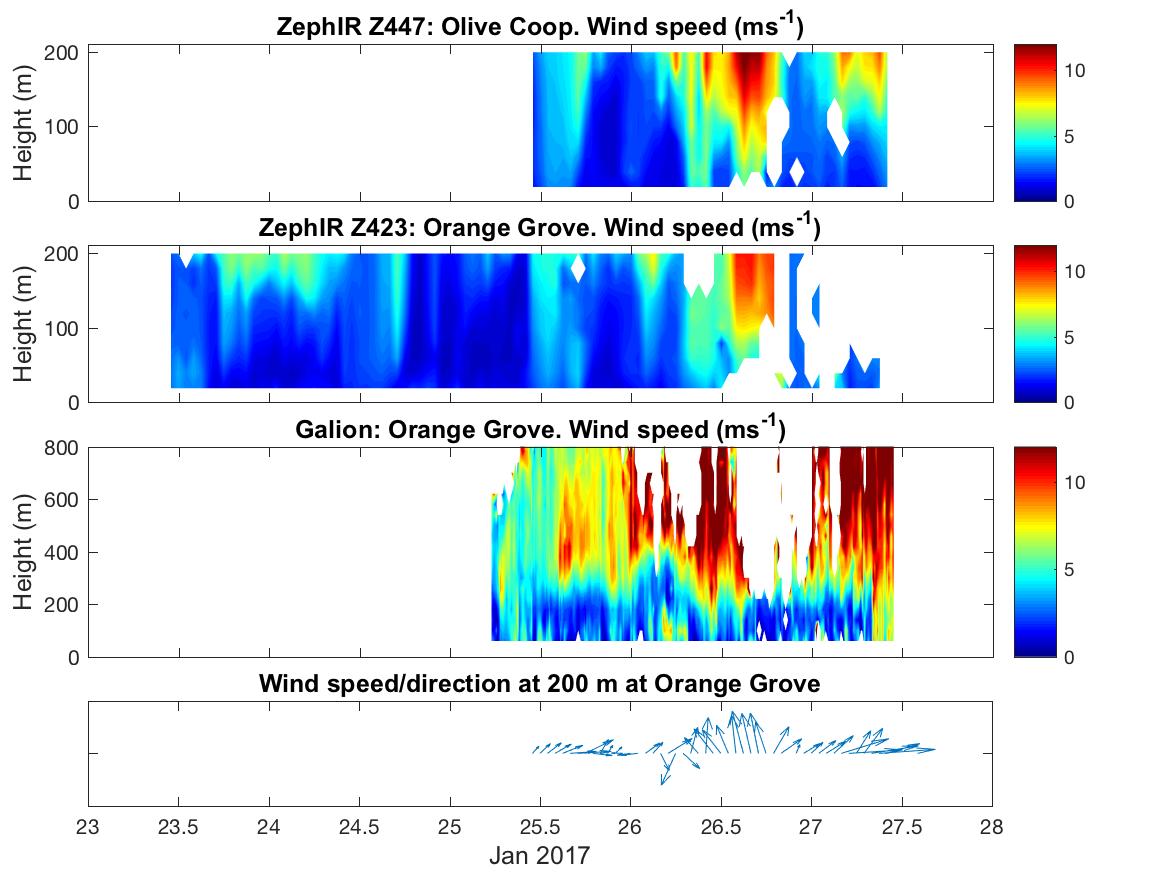 Summary of wind speed and direction data from the 3 lidars