Overview
Under funding from NSF we are testing a potentially transformative concept - use of data from seismographs
to detect, characterize and quantify extreme sustained wind events and wind gusts. Step 1 in this process was to collate and analyse wind gust data from the NWS ASOS network and use it to derive a gust climatology for the contiguous USA (Letson et al., in press).
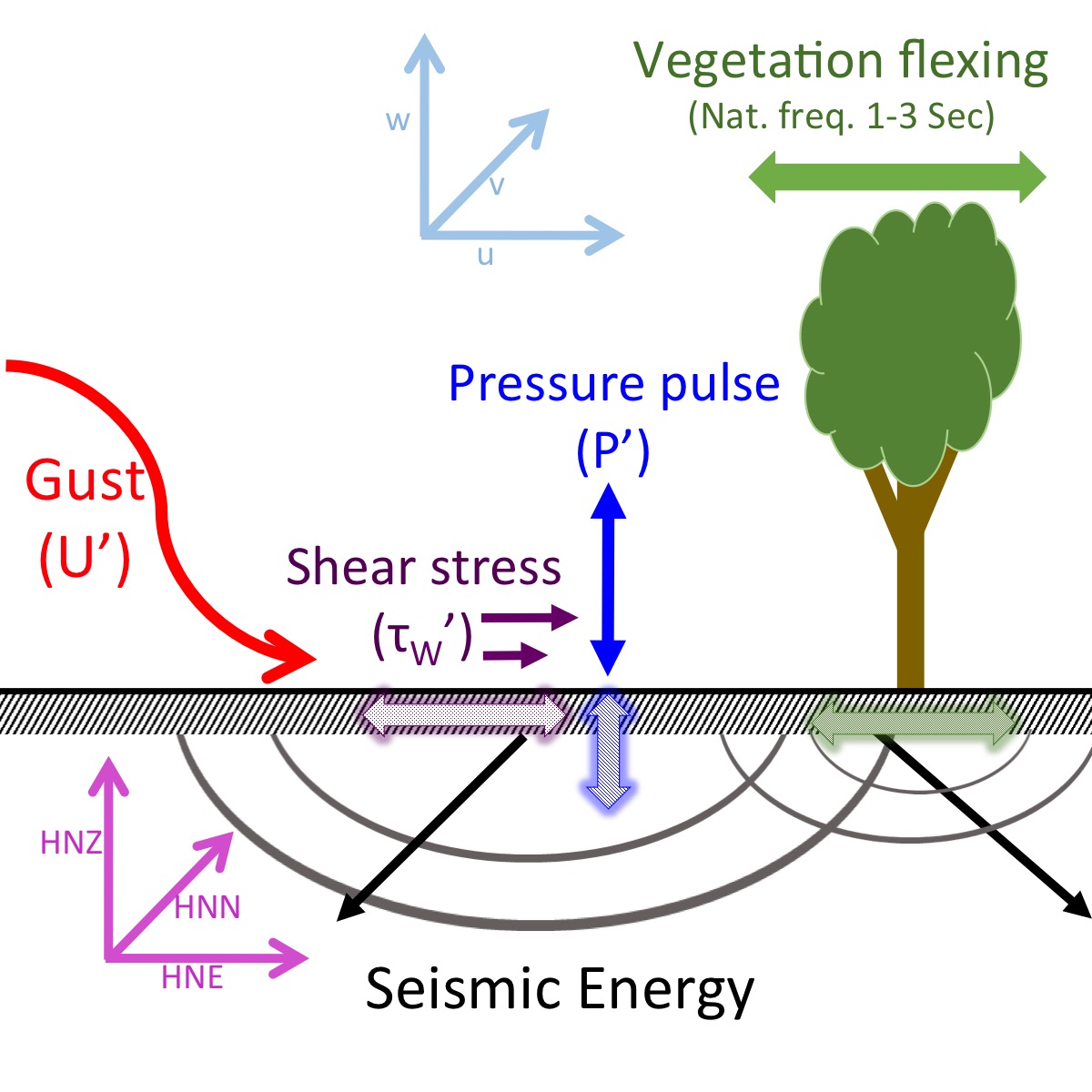
Our objective is to determine the degree to which seismic arrays can be used to quantify the occurrence, intensity and directional orientation of wind gusts and intense sustained wind speeds. We will analyze seismic data from the Transportable Array (TA) of the EarthScope program, and meteorological observations from NWS ASOS stations, and TA meteorologically enhanced stations distributed across the contiguous US. Using a suite of data analytics we will determine: Under what conditions high surface winds (both sustained winds and gusts) produce a signal in the seismometers, the frequency of the signal, and the generalizability of the relationship between wind gust magnitude and seismic response.
Under funding from the ACSF we are testing a related and equally potentially transformative concept - use of data from seismographs
in condition (i.e. health) monitoring of built structures.
Our work on the potential transdiciplinary use of seismic analyses is high-risk high-reward, and is being featured on the Incorporated Research Institutions for Seismology (IRIS) website. Click here to visit their site and view their summary
Video
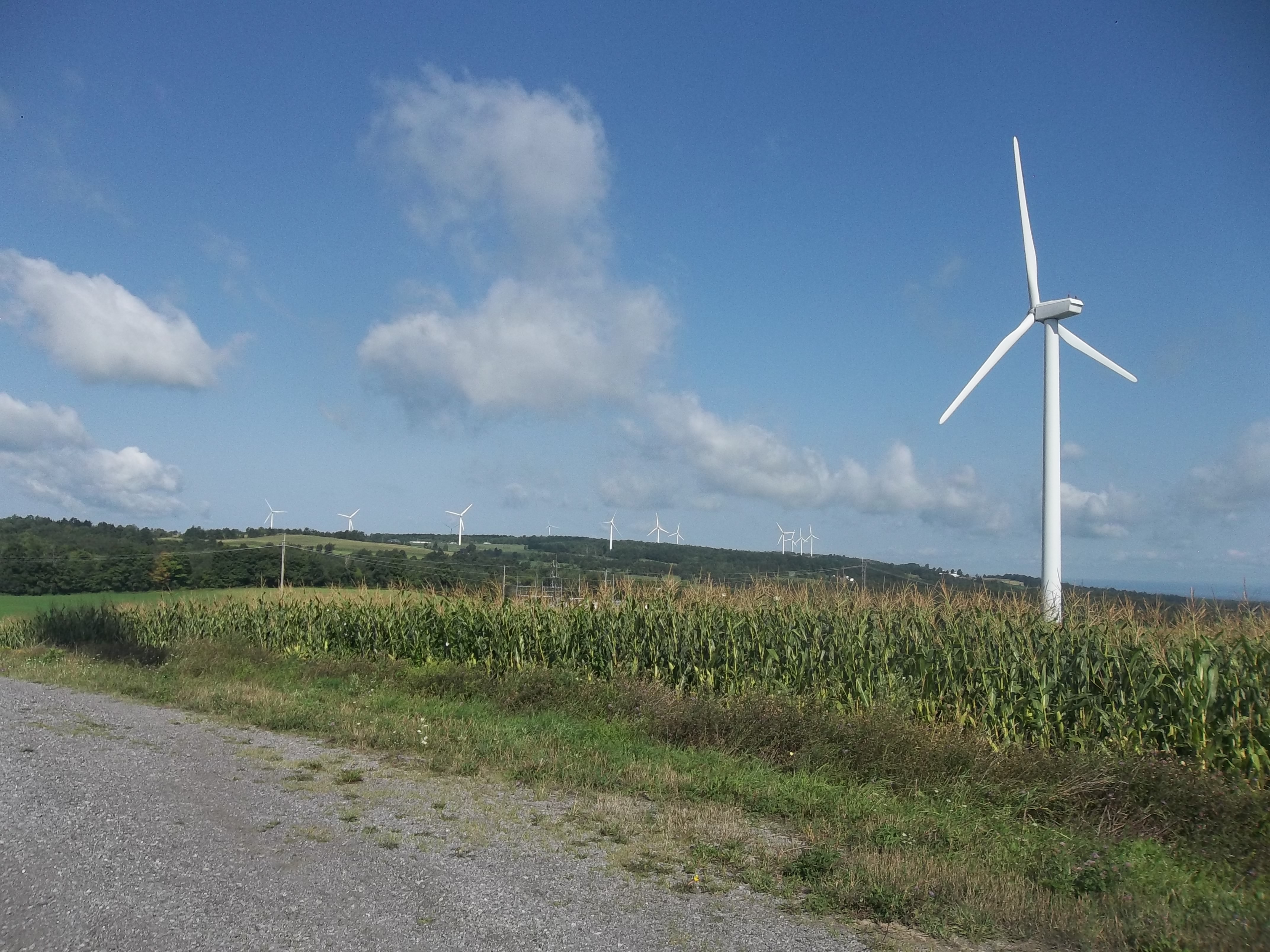
Equipment deployed at a wind farm in northern New York State
We have deployed sonic anemometers and barometers, along with seismometers on loan from the NSF funded Incorporated Research Institutions for Seismology (IRIS) Portable Array Seismic Studies of the Continental Lithosphere (PASSCAL) Instrument Center and EarthScope USArray Array Operations Facility (AOF). Click on any photo to enlarge. Click again to hide.
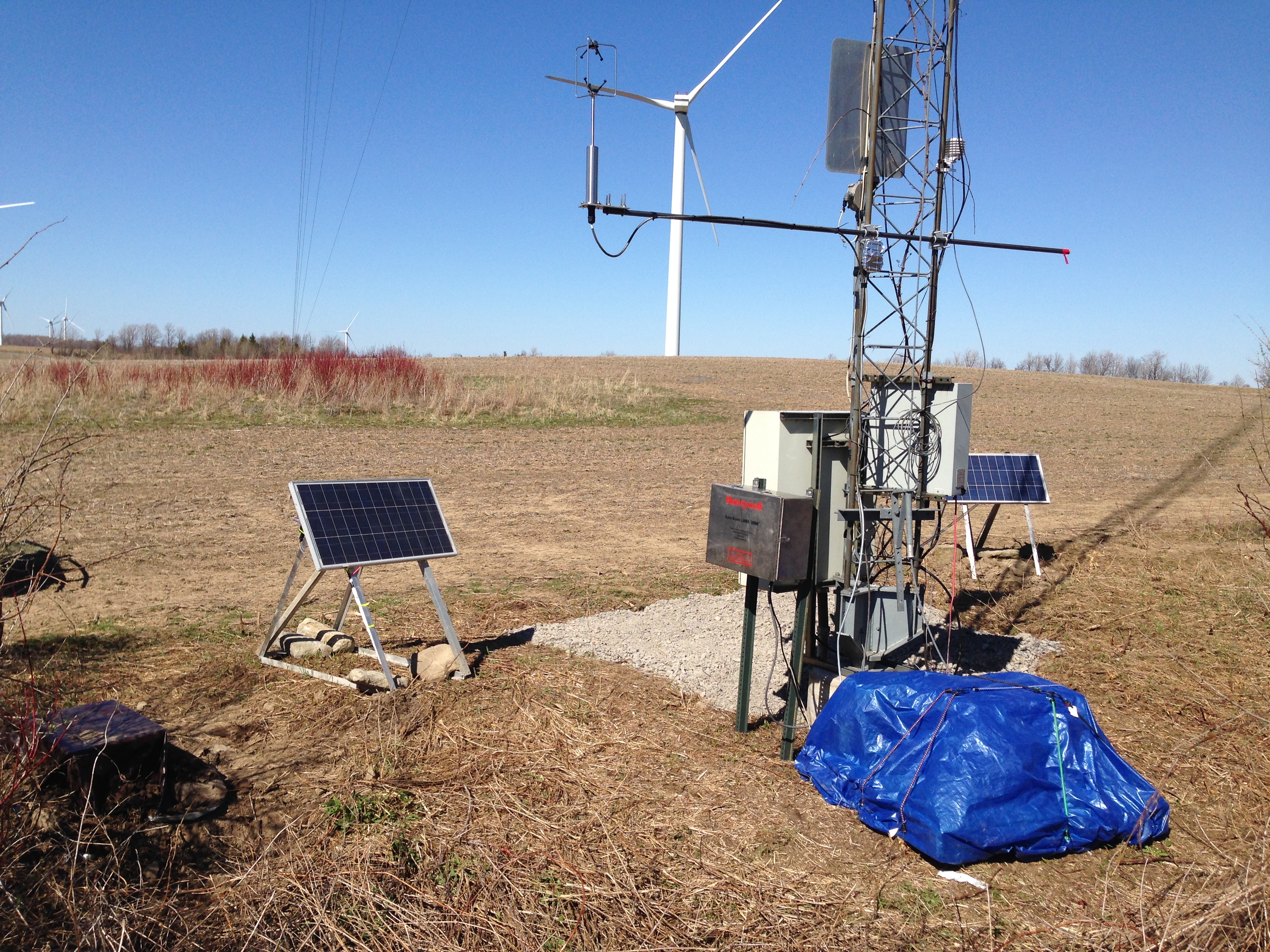 Meteorological mast with barometer and sonic anemometers
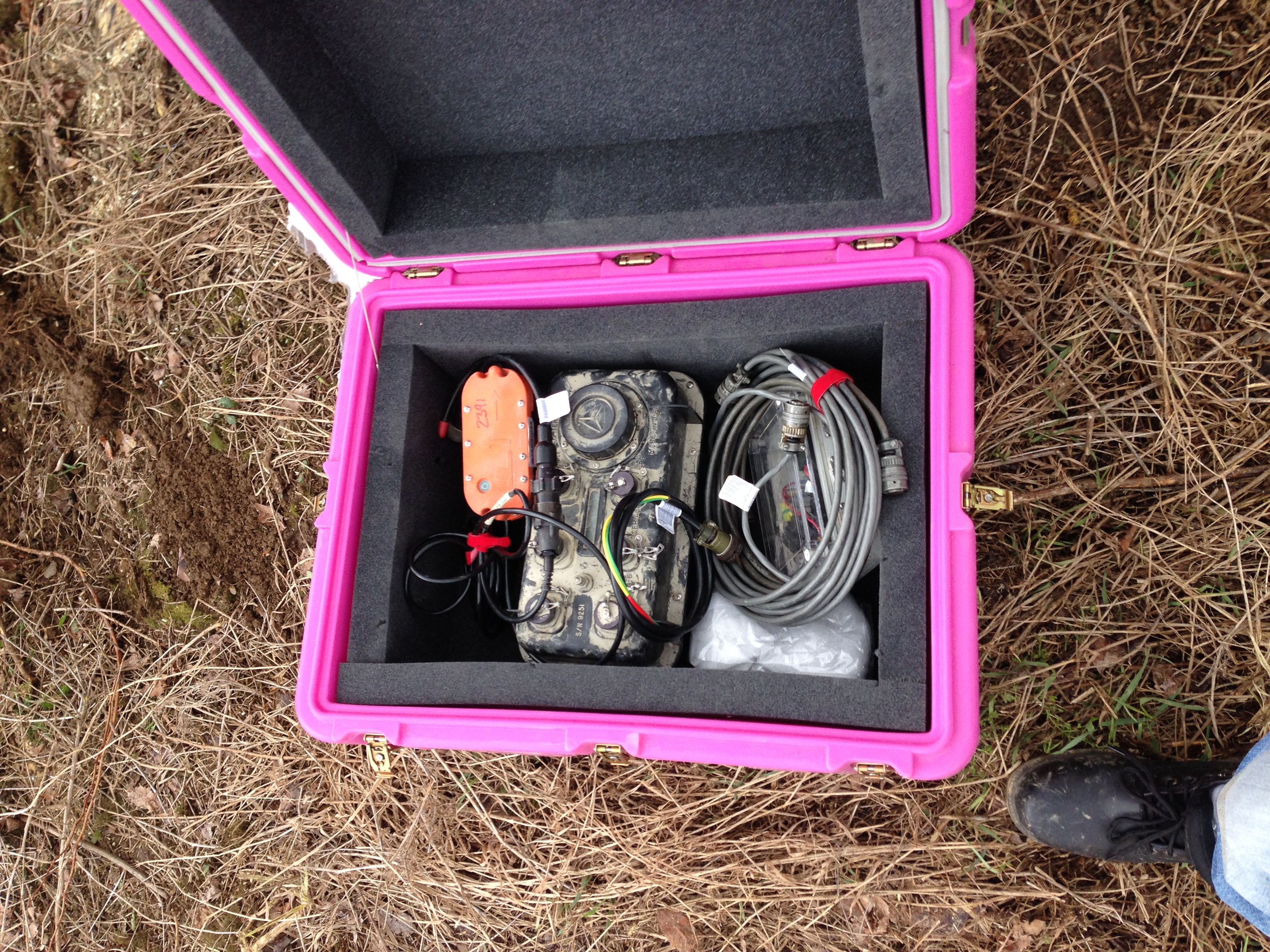 Seismic Data Acquisition System (DAS)
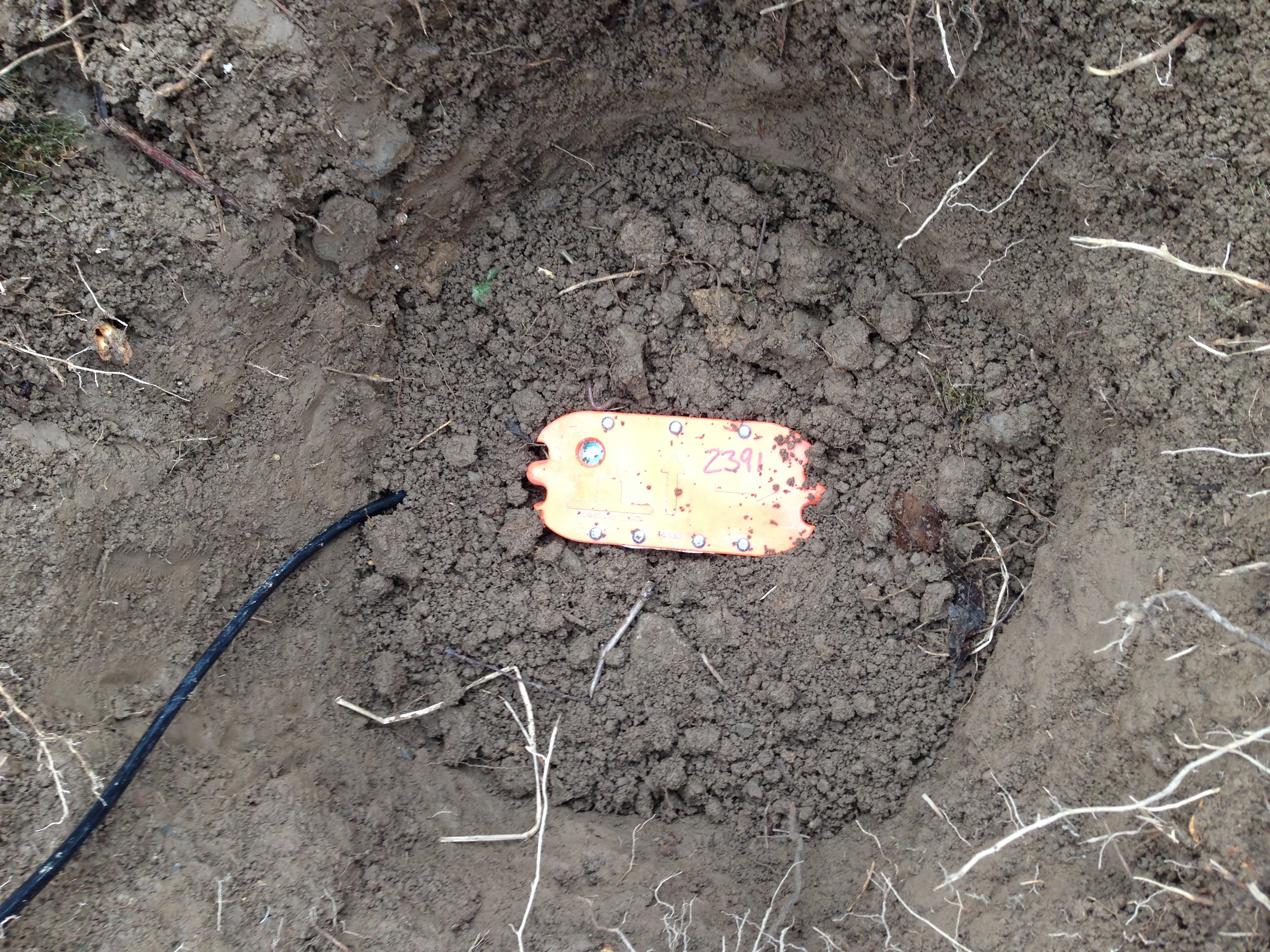 Geophone
 In Aug 2016 we deployed a number of seismometers at the wind farm for condition monitoring
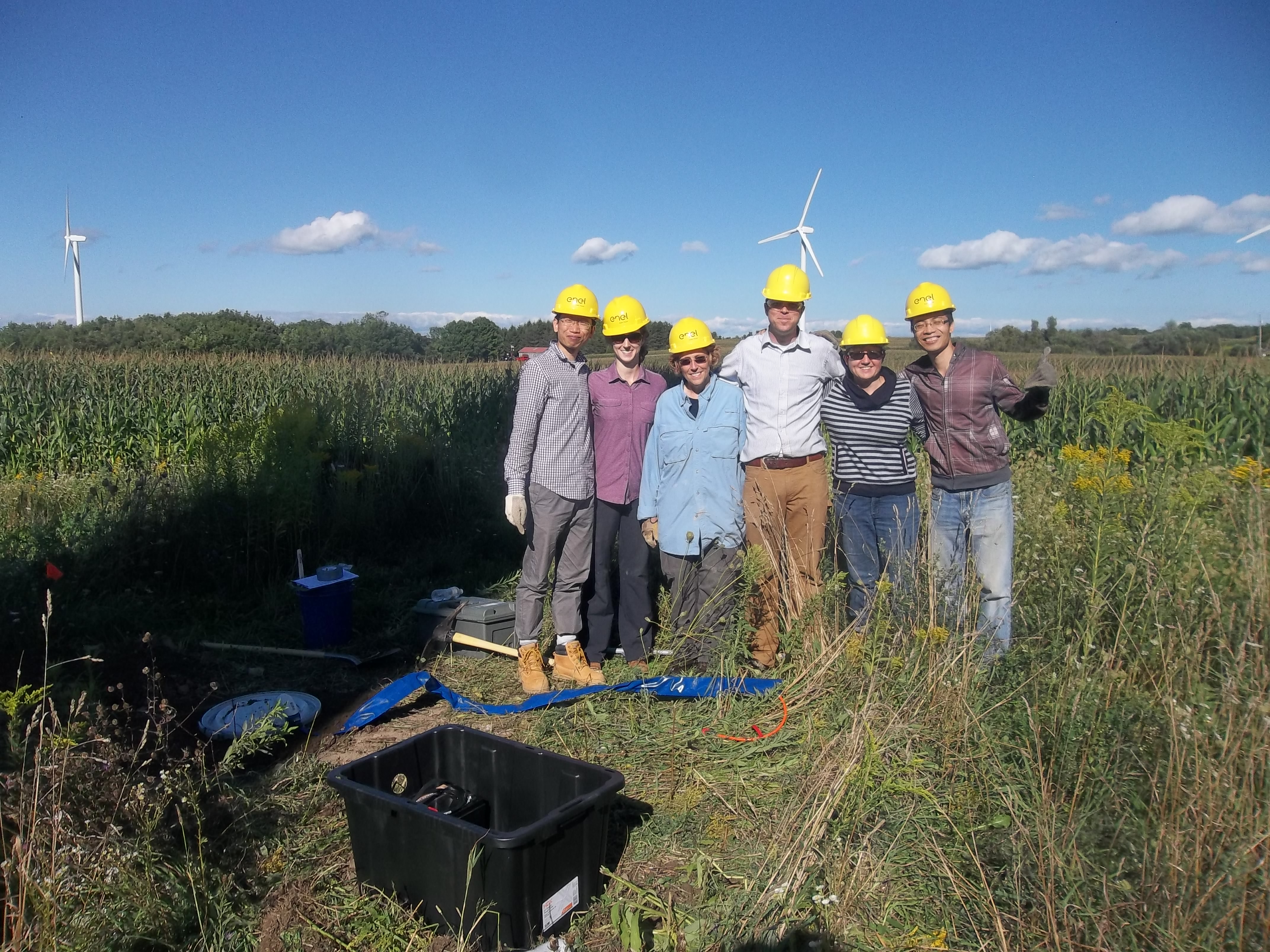 Part of the team celebrates a completed installation of an STS-2 sensor
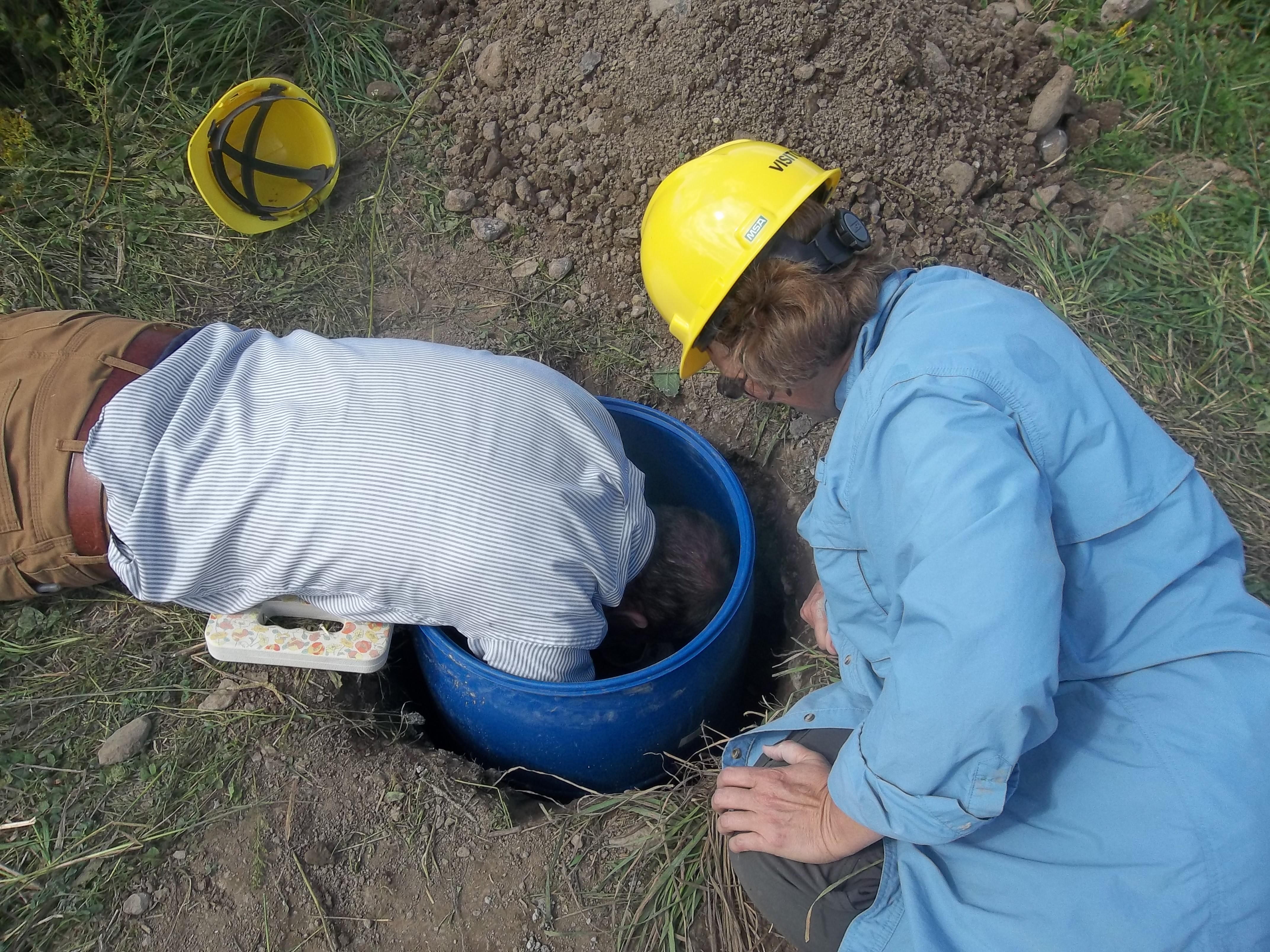 Lowering the broadband seismometer into the vault (thank heavens for long arms!)
Methodologies & Results
Below we show some figures that depict both our methodologies and some project results. The first two images in the upper row illustrate the impact of WT operation on seismic signals near the base of a WT. More details can be found in Hu et al. (2017, JSEE). The second two images in the upper row illustrate the occurrence of wind gusts and their seismic response (see 2nd image in the 2nd row for the precise stations used in this analysis on gust detection). More details can be found in Hu et al. (2017, JGR). The first image in the second row is an illustrative image of a wind gust from our sonic anemometer measurements at Fenner. Details about our gust climatology from anemometer measurements are given in Letson et al. (2018, JWEIA). The last two panels illustrate the final piece of analysis in our research - our assessment of the factors that determine gust - seismic responses and the potential for gust magnitude detection from seismic data. More details will be given in a manuscript that is currently under preparation.
Click on any image to enlarge. Click again to hide.
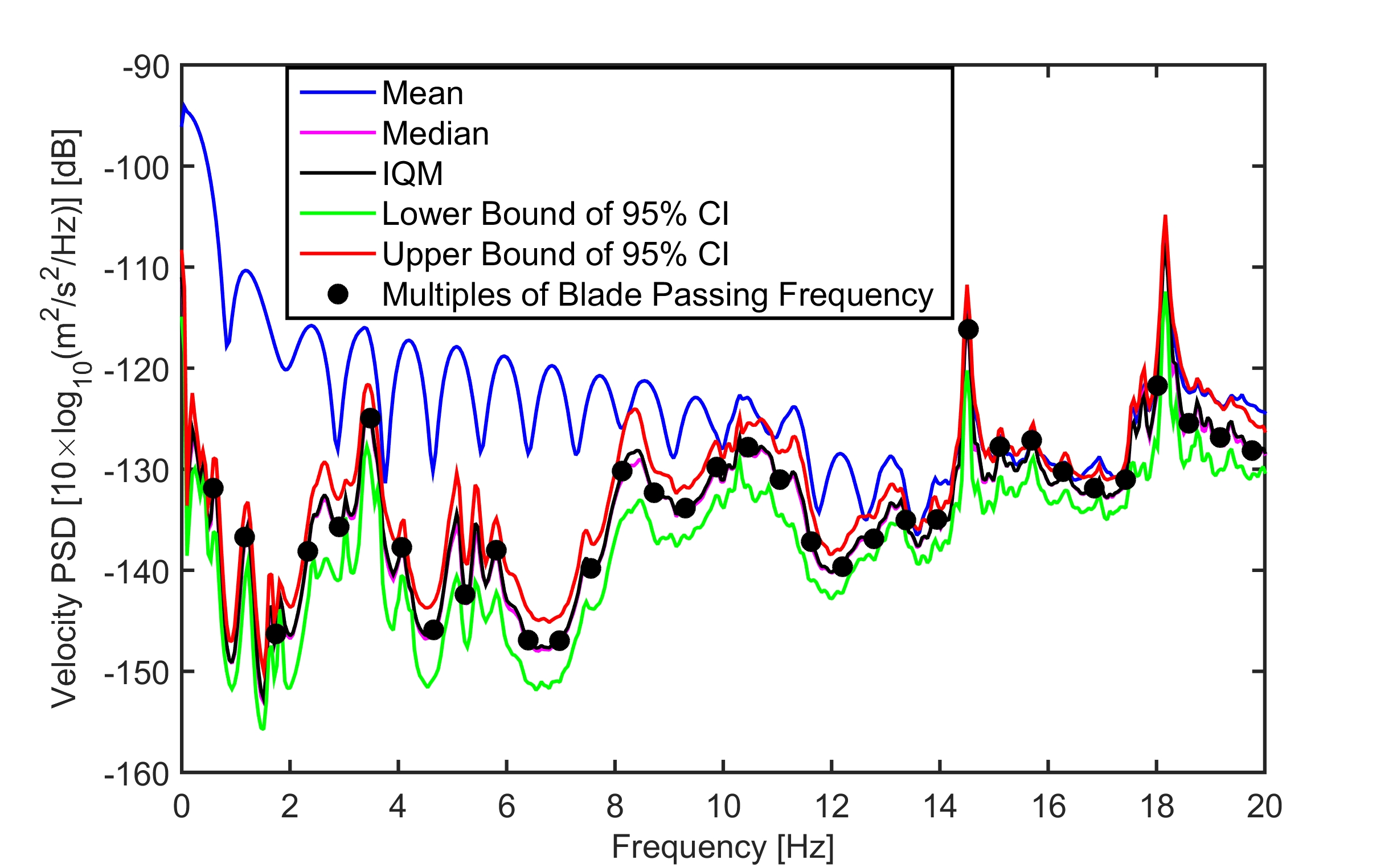 Wind turbine blade passing frequency signatures have been detected in the velocity power spectral density of seismic data collected nearby wind turbines
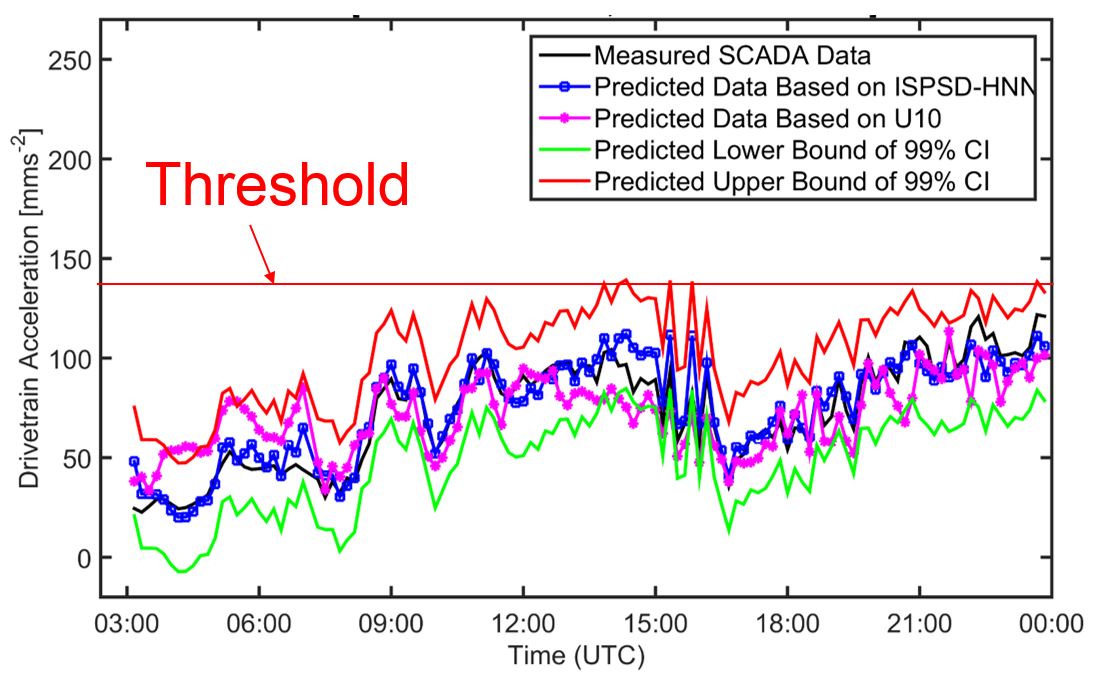 Extreme wind turbine tower and drivetrain acceleration (illustrated here) has been accurately detected by using the seismic-based condition monitoring approach
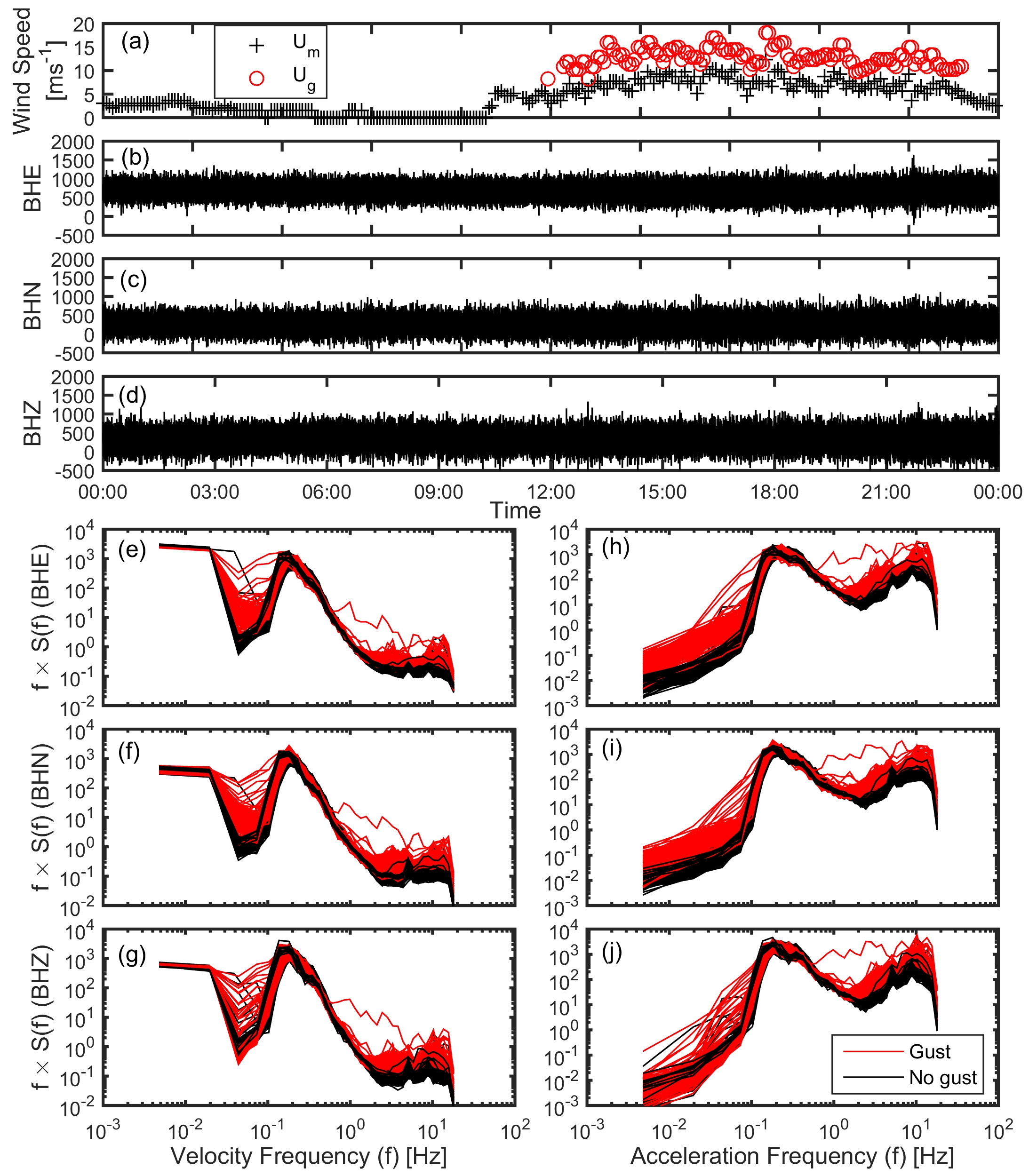 Power Spectral Analyses of Seismic Data During Gust Periods and Without Gusts.
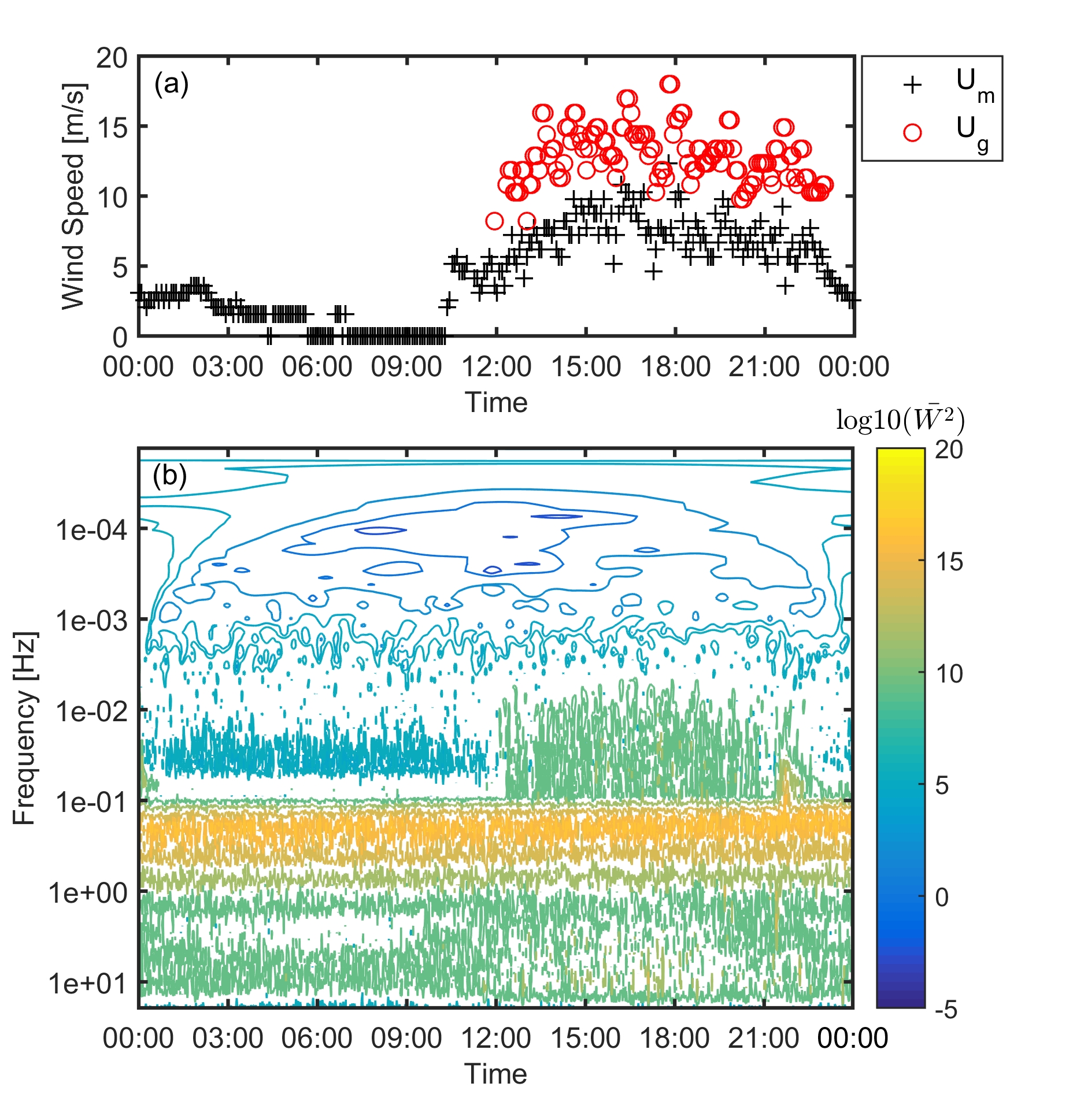 Wavelet Analysis of Seismic Data. Note the enhancement of variance in f=0.01-0.1 Hz during the period of gusts
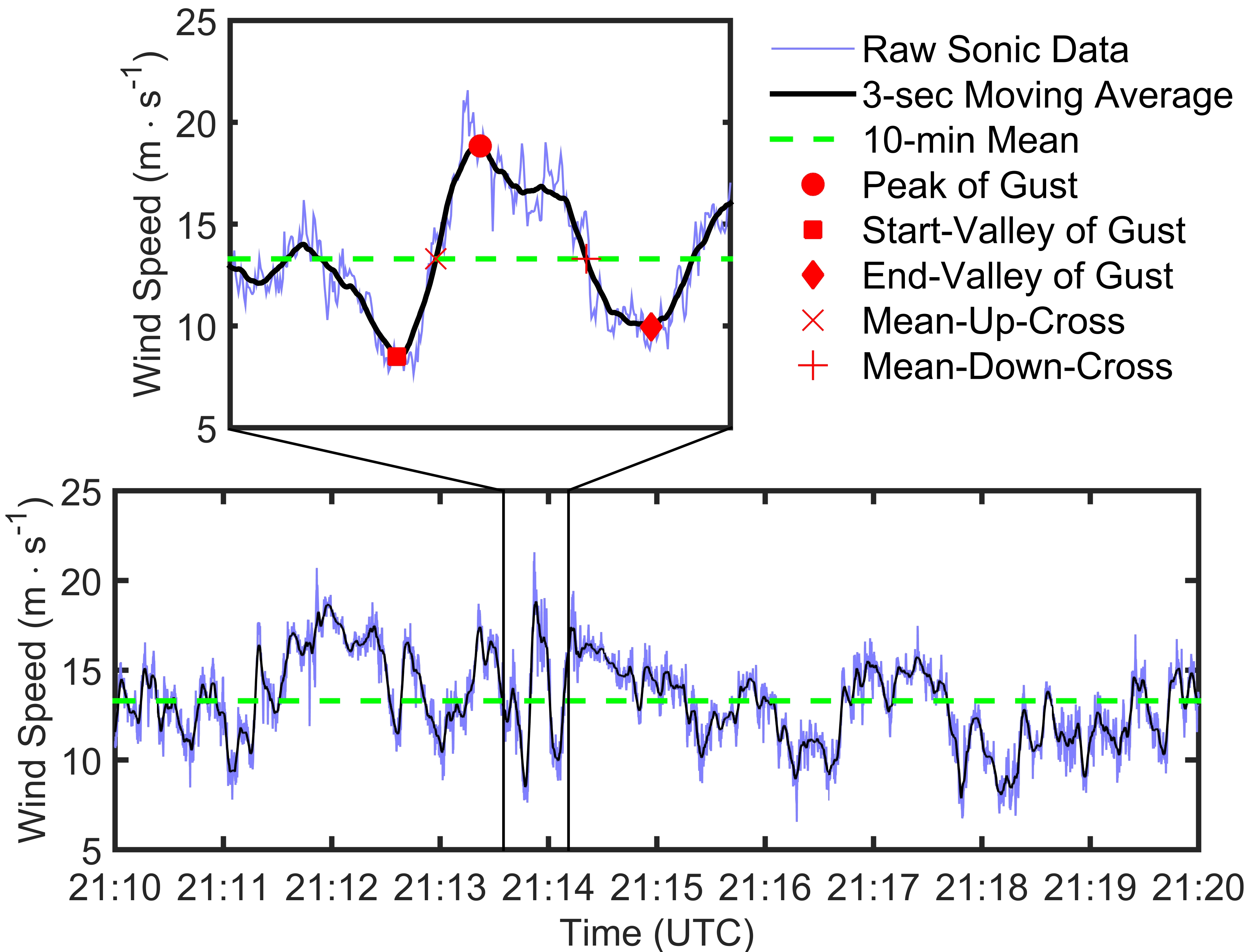 One measured gust in a 10-min horizontal wind speed
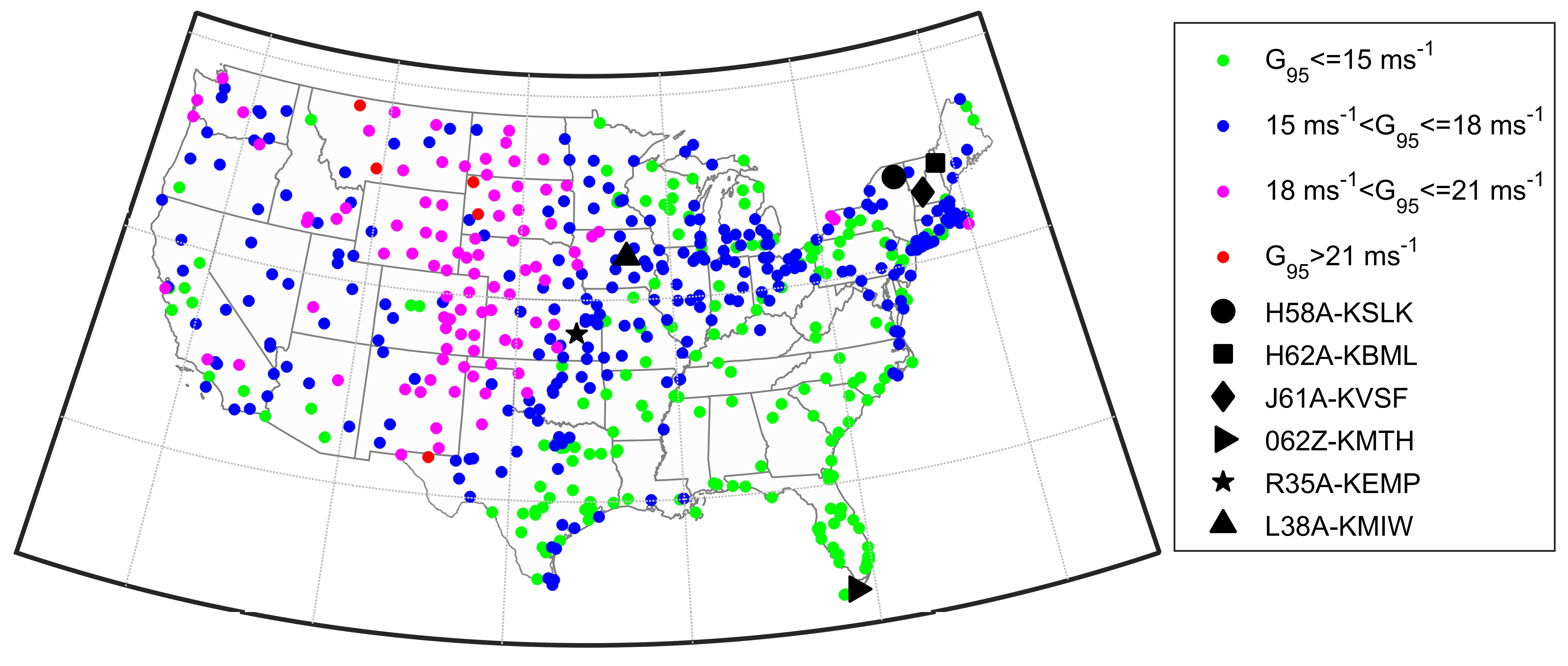 ASOS Gust Map & TA-ASOS Station Pairs used in our Analyses
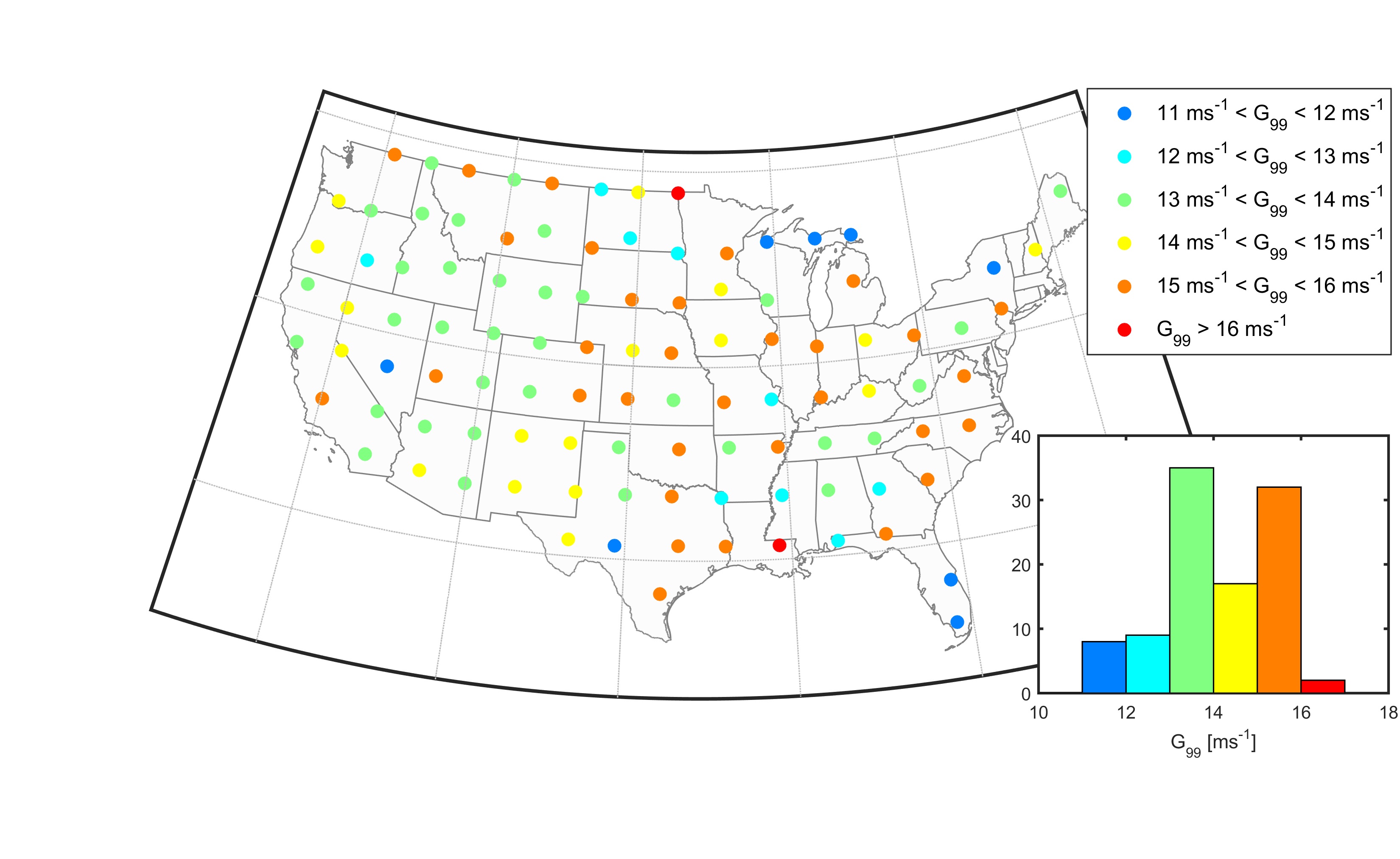 Seismic-based estimates of 99th percentile of gust speeds at 103 Transportable Array stations
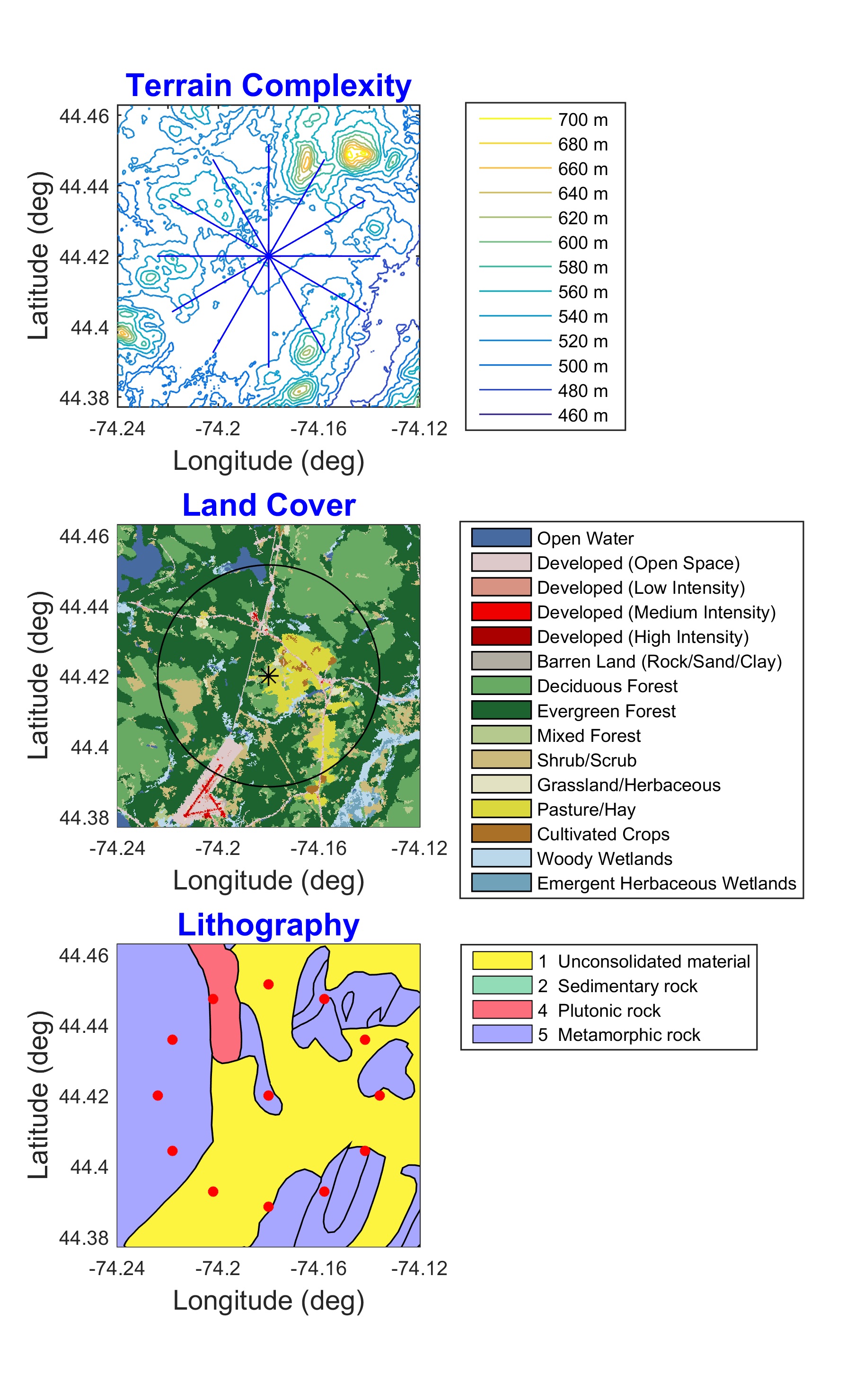 A very detailed site analyses for an example TA site H58A (site used in the work to the left)
Publications
Scientific Journals
TOPIC:Wind gusts & seismic noise
Hu W., Barthelmie R.J., Letson F. and Pryor S.C.(2019): Seismic noise induced by wind turbine operation and wind gusts. Seismological Research Letters (SRL-D-19-00095) In press.
Letson F.W., Barthelmie R.J., Hu W., Brown L.D. and Pryor S.C. (2019): Wind gust quantification using seismic measurements. Natural Hazards doi:10.1007/s11069-019-03744-8.
Hu W., Letson F., Barthelmie R.J., and Pryor S.C. (2018): Wind gust characterization at wind turbine relevant heights in moderately complex terrain. Journal of Applied Meteorology and Climatology 57 1459-1476.
Letson F., Pryor S.C., Barthelmie R.J., and Hu W. (2018): Observed gust wind speeds in the coterminous United States, and their relationship to local and regional drivers. Journal of Wind Engineering and Industrial Aerodynamics 73 199-209.
Hu W., Pryor S.C., Letson F., Tytell J., and Barthelmie R.J. (2017): Investigation of gust-seismic relationships and applications to gust detection. Journal of Geophysical Research: Atmospheres 122 140-151.
TOPIC: Innovative approaches to WT condition monitoring using seismometers
Hu W., Barthelmie R.J., Letson F. and Pryor S.C.(2019): Seismic noise induced by wind turbine operation and wind gusts. Seismological Research Letters (SRL-D-19-00095) In press.
Hu W., Barthelmie R.J., Letson F., and Pryor S.C. (2019): A new seismic-based condition monitoring approach for wind turbines. Wind Energy 22 473-486.
Hu W., Pryor S.C., Letson F., and Barthelmie R.J. (2017): Using seismic analyses for the wind energy industry. Journal of Solar Energy Engineering 139(5) 051007 (SOL-17-1079, doi: 10.1115/1.4037218).
Trade magazines
Barthelmie R.J. and Pryor S.C. (2017): Flow characterization in complex terrain: Use of lidars to quantify flow and wind turbine wakes. WindTech International, 13 #5 p6-9 (Invited Feature).
Pryor S.C., Hu W., Letson F. and Barthelmie R.J. (2016): Applications of seismic analyses to the wind energy industry. EnergyTech Magazine, November 2016 issue, 8pp http://www.energy-tech.com/advanced_energy/article_0b281b0c-a5f4-11e6-ad6e-4fcbdc8c0992.html
Conference presentation/papers
Pryor S.C., Barthelmie R.J., Brown L.D., Hu W. and Letson F.W. (2017): How can use of seismometers advance the wind energy industry? Wind Energy Science conference, Technical University of Denmark, Lyngby, June 2017.
Hu W., Pryor S.C., Letson F. and Barthelmie R.J. (2017): Using seismic analyses in the wind energy industry. ASME Power & Energy Conference, Charlotte NC, June 2017 (7pp abstract).
Letson F., Hu W., Barthelmie R.J., Tytell J. and Pryor S.C. (2017): Wind gust quantification using seismic measurements. ASME Power & Energy Conference, Charlotte NC, June 2017 (8pp abstract).
Pryor S.C., Hu W., Letson F. and Barthelmie R.J. (2017): A new approach to wind turbine condition monitoring. AWEA WindPower conference, Anaheim CA, May 2017 (4pp abstract).
Letson F., Pryor S.C., Hu W., and Barthelmie R.J. (2017): Wind gust quantification across the United States using seismic and sonic anemometers. AWEA WindPower conference, Anaheim CA, May 2017 (4pp abstract).
Hu W., Pryor S.C., Letson F., and Barthelmie R.J. (2016): Investigation of Gust-Seismic Relationships and Applications to Gust Detection. ASME 2016 Power and Energy conference, Charlotte NC, June 2016.
Pryor S.C., Hu W., Letson F., and Barthelmie R.J. (2016): Improved detection and quantification of wind gusts: Thinking outside the anemometer. 2016 Wind Energy Research Workshop, Lowell, MA, March 2016.
Team
Professor Sara C. Pryor, Earth and Atmospheric Sciences
Professor Rebecca J. Barthelmie, Mechanical and Aerospace Engineering
Dr. Weifei Hu, Post Doc
Dr. Fred Letson, Post Doc
We also owe a debt of thanks to the many graduate students who assisted us in the deployment of our seismic array!
Collaborators
Professor Larry Brown, Cornell U.
Professor Frank Vernon and Dr. Jon Tytell, Scripps, UCSD
The PASSCAL research team
ENEL North America
The town of Fenner
The Fenner Renewable Energy Education (FREE) center
Madison Country Parks
Ancillary data sources
ASOS Wind Data from National Centers for Environmental Information
Seismic Data from EarthScope Transportable Array
Back to top

 `
`