Overview

Objectives

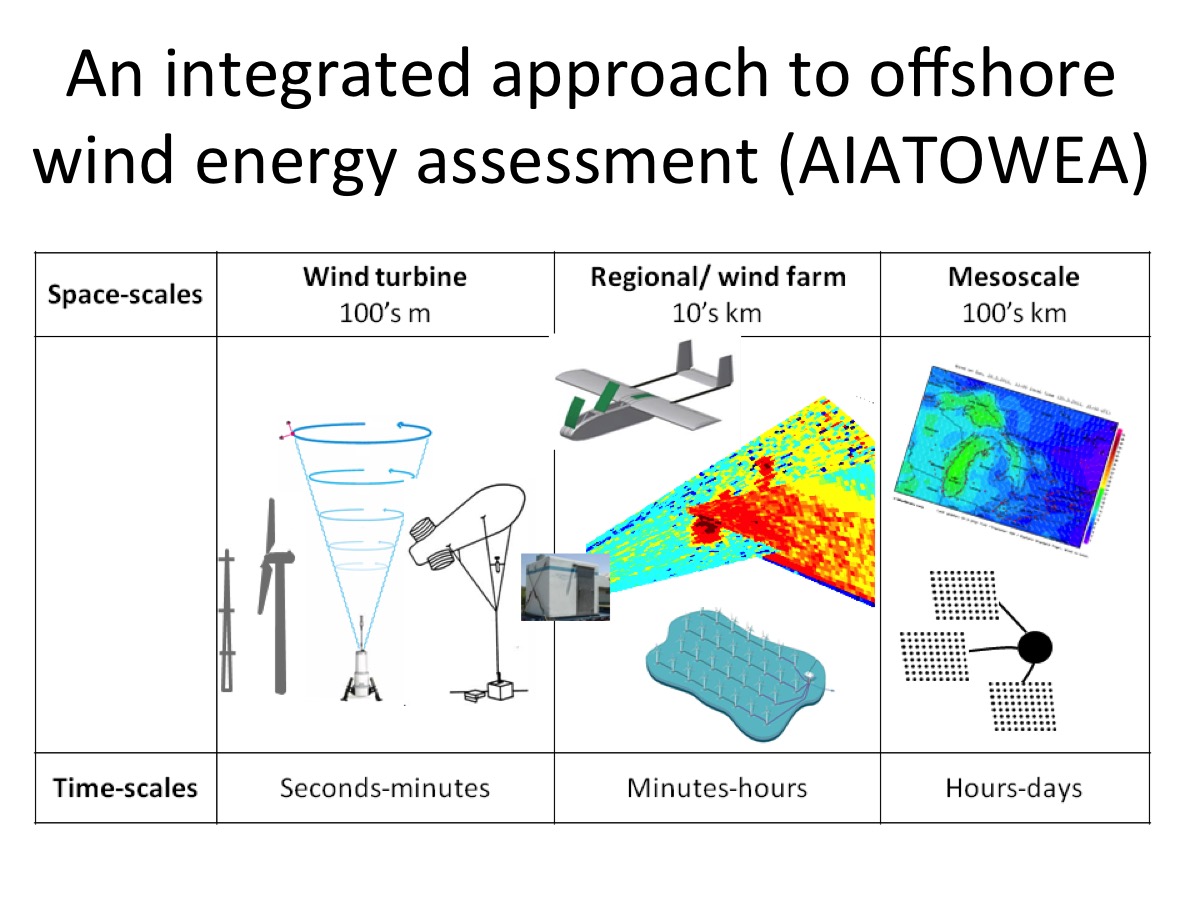
Our research is focused on wind energy resources and wakes. It is at the intersection between mechanical engineering and atmospheric science. We use both full-field scale measurements and modeling to optimize wind resource assessment and wind farm layout. We are especially interested in wind and turbulence measurements using lidar and wake measurement and modeling for large wind farms, particularly offshore and in complex terrain.
Offshore wind energy developments require uniquely accurate assessments of wind and turbulence characteristics away from the surface in the marine boundary-layer. This project (which ran from 2011-2016) is a public-private collaborative between academia and industry to effectively address offshore resource assessment and design condition needs. We will integrate ground-based remote sensing measurements (including multiple vertical and scanning lidar systems), observations from an Unmanned Aerial Vehicle (UAV) and a tethered balloon with in situ measurements from meteorological towers and satellite-borne radiometers to define horizontal/vertical gradients of both wind speed and turbulence at high temporal and spatial resolution in the coastal/offshore areas of Lake Erie, in an area that has been earmarked for offshore wind farm development. The datasets to be collected within the project will be (i) linked to existing resource estimates, (ii) used in a closure (instrument inter-comparison) analysis based in part on the in situ observations, (iii) used to evaluate meteorological and wind farm models (iv) analyzed to characterize meteorological conditions in the coastal Great Lakes region where highly resolved observations are currently lacking, and (v) used to develop best-practice strategies and documentation for each measurement type focused on its application to wind energy.
Here is the project abstract.

Specific Objectives

  • (i)To evaluate the potential of use of innovative (ground-based and satellite-borne) remote sensing technologies in offshore wind energy resource assessments.
  • (ii) To promote greater understanding of the variability of wind and turbulence in offshore and coastal areas at heights and scales and precision/accuracy of relevance to wind energy using a combination of remote sensing, in situ measurements and state-of-the-art model tools.
  • (iii) To develop a uniquely detailed and integrated dataset for model validation efforts focused on the temporal and spatial variability of potential power at turbine hub-heights and turbulence generated loads across the wind turbine rotor plane.
  • (iv) To develop instrument deployment, and data analysis and integration protocols codified in a bestpractice report.

    Outcomes

    In addition to the 14 international refereed journal papers listed below, more than 60 conference papers and presentations were given and a special session organized on the results of the Prince Edward Island experiment at the WindTech 2 conference held at Western University in October 2015. Two graduate students (Wang and Doubrawa) and one Post Doc (Smith) participated in the project under the supervision of Professor Barthelmie and were partially supported by this project. Both students have successfully graduated with M.Eng and Ph.D. from Cornell University and one student was supported at Case Western University who graduated with a M.Sc. degree.
    During the project we collaborated with multiple partners in field campaigns applying lidar technologies and other state-of-the-art instrumentation to improve error quantification for measurements with lidar and advance methods that can be applied to optimze lidar scan geometries. We have further improved understanding of atmospheric flow parameters of relevance to the wind energy industry and wind turbine wake characteristics for wind turbine resource assessment, siting and load assessment in complex terrain.
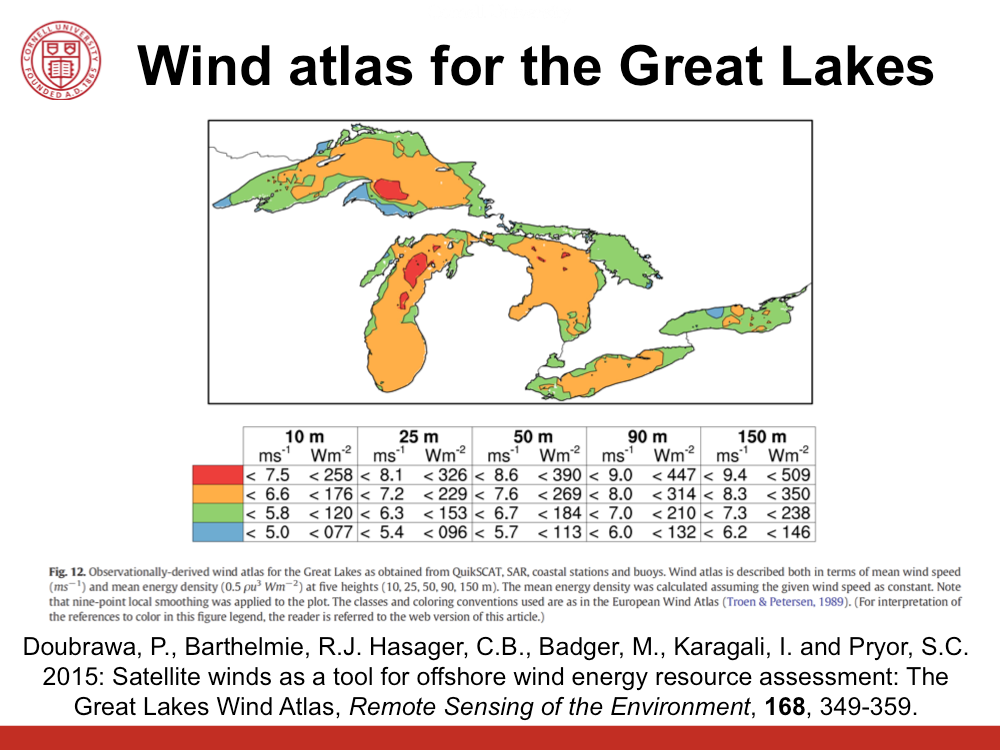
    The Great Lakes are increasingly the focus of discussions regarding offshore wind turbine deployments, but there remains unacceptably large uncertainty in the likely wind resource. Thus, a highly innovative approach was undertaken to develop a homogeneous wind atlas for the Great Lakes using a unique integration of remote sensing data (from QuickSCAT and Synthetic Aperture Radar), in situ measurements (from buoy and coastal masts), reanalysis products and numerical models to generate low error wind fields. This new Great Lakes Wind Atlas can be downloaded below in the Data section.
    In a broader context from work arising in this project, we also published papers that propose a new more accurate model for use the standards relating to turbulence in the offshore environment (Wang et al. 2014a), that indicate that implementation of moderate wind energy scenarios can have a meaningful impact on reducing greenhouse gases emissions (Barthelmie and Pryor 2014) and examine how the cost of offshore wind turbine deployments is related to factors such as the distance of the wind farm to the coast and its size (Sovacool et al. 2016). See details in the papers (full citations are given below in the Journal Publications section).

    Outcomes by Specific Objectives

  • (i)To evaluate the potential of use of innovative (ground-based and satellite-borne) remote sensing technologies in offshore wind energy resource assessments.
  • This research led to one of our key research products: A new Wind Atlas for the Great Lakes. The output from the Atlas is available here: Zipped netcdf file is here . and the citation associated with that product is: Doubrawa, P., Barthelmie, R.J. Hasager, C.B., Badger, M., Karagali, I. and Pryor, S.C. 2015: Satellite winds as a tool for offshore wind energy resource assessment: The Great Lakes Wind Atlas, Remote Sensing of the Environment, 168, 349-359.

    Our research also developed new methodologies for characterization of and reduction of uncertainty associated with lidar retrievals of flow. details are given in: Wang, H., Barthelmie, R.J., Doubrawa, P. and Pryor, S.C. 2016: Errors in radial velocity variance from Doppler wind lidar, Atmospheric Measurement Techniques, 9, 4123-4139. doi:10.5194/amt-9-4123-2016 and Wang, H., Barthelmie, R.J., Pryor, S.C. and Brown, G.: 2016 Lidar arc scan uncertainty reduction through scanning geometry optimization, Atmospheric Measurement Techniques, 9, 1653–1669 doi: amt-9-1653-2016 and Wang, H., Barthelmie R.J., Clifton, A. and Pryor S.C. 2015: Wind measurements from arc scans with doppler wind lidar, Journal of Atmospheric and Oceanic Technology, 32, 2024-2040, doi: 0.1175/jtech-d-14-00059.1.
    Lastly, we also advanced new approaches to characterization of wind turbine wakes using lidar measurements. Our results and methodology are reported in: Doubrawa, P., R. J. Barthelmie, H. Wang, S. C. Pryor, and M. Churchfield, 2016: Wind turbine wake characterization from temporally disjunct 3-D measurements. Remote Sensing, 8, 939; doi:10.3390/rs8110939

  • (ii) To promote greater understanding of the variability of wind and turbulence in offshore and coastal areas at heights and scales and precision/accuracy of relevance to wind energy using a combination of remote sensing, in situ measurements and state-of-the-art model tools.
  • This was the major thrust of our research. two of our experiments (#3 and #4) addressed this issue specifically. Our research shows:
    The frequent presence of upward momentum and resulting distortion fo the wind speed profile at turbine relevant heights due to swells in the Great Lakes. And the freuqent presence of low level jets at 600 m height over the Lake and occasions when the wind speed profile across the rotor plane may be impacted by this phenomenon. The citation for this finding is Wang, H., R. J. Barthelmie, P. Crippa, P. Doubrawa, and S. C. Pryor, 2014: Observations of Coastal Atmospheric Boundary Layer over Lake Erie. Journal of Physics: Conference Series, 524 012117.
    That at 10-14 m escarpment adcajent to long-overseas fetch the zone of wind speed decrease before the terrain feature and the increase at (and downwind of) the escarpment is ~3–5% at turbine hub-heights. A region of high turbulence was indicated close to the escarpment that extended through the nominal rotor plane, but the horizontal extent of this region was narrow (<10 times the escarpment height, H) in both models and observations. While flow angles close to the escarpment were very complex, by a distance of 10 H, flow angles were <3° and thus well within limits indicated by design standards. The citation for these findings is: Barthelmie, R.J., Doubrawa, P. Wang, H., Giroux, G., Pryor, S.C. 2016: Effects of an escarpment on flow parameters of relevance to wind turbines, Wind Energy, 19, 2271-2286.

  • (iii) To develop a uniquely detailed and integrated dataset for model validation efforts focused on the temporal and spatial variability of potential power at turbine hub-heights and turbulence generated loads across the wind turbine rotor plane.
  • The 4 experiments all contributed to our efforts in this regard, culminating in our work within Exp#4 where we developed a measurement strategy that permitted direct model V&V for a CFD code. The citation for that work is: Barthelmie, R.J., Doubrawa, P. Wang, H., Giroux, G., Pryor, S.C. 2016: Effects of an escarpment on flow parameters of relevance to wind turbines, Wind Energy, 19, 2271-2286. `

    Our work also used lidar remote sensing and in situ measurements to address a key area of research; how do large onshore wind farms impact local-regional climate? Our research clearly showed that at 2.1 km, or 26 D downstream of the closest wind turbine, but in the wake of the whole wind farm, no significant reduction of hub-height wind speed or increase in TI was observed, especially during daytime. Thus, in high turbulence regimes even very large wind installations may have only a modest impact on down-stream flow fields. No impact is observable in daytime vertical temperature gradients at downwind distances of > 2 km, but at night the presence of the wind farm does significantly decrease the vertical gradients of temperature (though the profile remains stably stratified), largely by increasing the temperature at 2 m. Citation for this research is: Smith, C.M., Barthelmie, R.J. and Pryor, S.C. 2013: In situ observations of the influence of a large onshore wind farm on near-surface temperature, turbulence and wind speed profiles. Environmental Research Letters, 8, 034006

  • (iv) To develop instrument deployment, and data analysis and integration protocols codified in a bestpractice report.

    We have written and published a best practise report - available here: Barthelmie, R.J., Wang, H.., Doubrawa, P. and Pryor, S.C. 2016: Best practise for measuring wind speeds and turbulence offshore through in-situ and remote sensing technologies. Report to Department of Energy. DE- EE0005379. 7 July 2016. 47 pp. http://doi.org/10.7298/X4QV3JGF.
    From our Exp#1 we also published a paper in BAMS that discussed some of the challenges to, and data integration methods employing appropriate metrics for instrument closure analyses between remote sensing and in situ measurement platforms. The citation for that work is: Barthelmie, R.J., Crippa, P., Wang, H., Smith, C.M., Krishnamurthy, R., Choukulkar, A., Calhoun, R., Valyou, D., Marzocca, P., Matthiesen, D., Brown, G. and Pryor, S.C. 2013: 3D wind and turbulence characteristics of the atmospheric boundary-layer. Bulletin of the American Meteorological Society, 95, 743–756.
    From out Exp#4 we developed a methodology to integrate experiment data with CFD output for assessment of model fidelity. The citation for that work is: Barthelmie, R.J., Doubrawa, P. Wang, H., Giroux, G., Pryor, S.C. 2016: Effects of an escarpment on flow parameters of relevance to wind turbines, Wind Energy, 19, 2271-2286.

    Research priorities: Next steps

    While significant progress was achieved in the project (see details below), further work is urgently needed to: (1) Improve understanding how wind turbines interact with the atmosphere in large wind farms particularly those deployed in large arrays offshore and in complex terrain. One of the major outstanding questions for offshore wind farm development relates to optimum spacing of wind turbines in large offshore wind farms in terms of power output and loading where models have been shown to underperform (Barthelmie et al. 2013). (2) Generate more high-quality observational data sets in the coastal zone and in operating offshore wind farms for model development and evaluation (Barthelmie and Pryor 2013). (3) Continue to characterize (and improve) lidar performance in the highly inhomogeneous flow environments (see Wang et al. 2016). This research thus is a component our one of our new NSF grants -See details here

    Back to top

    Experiments

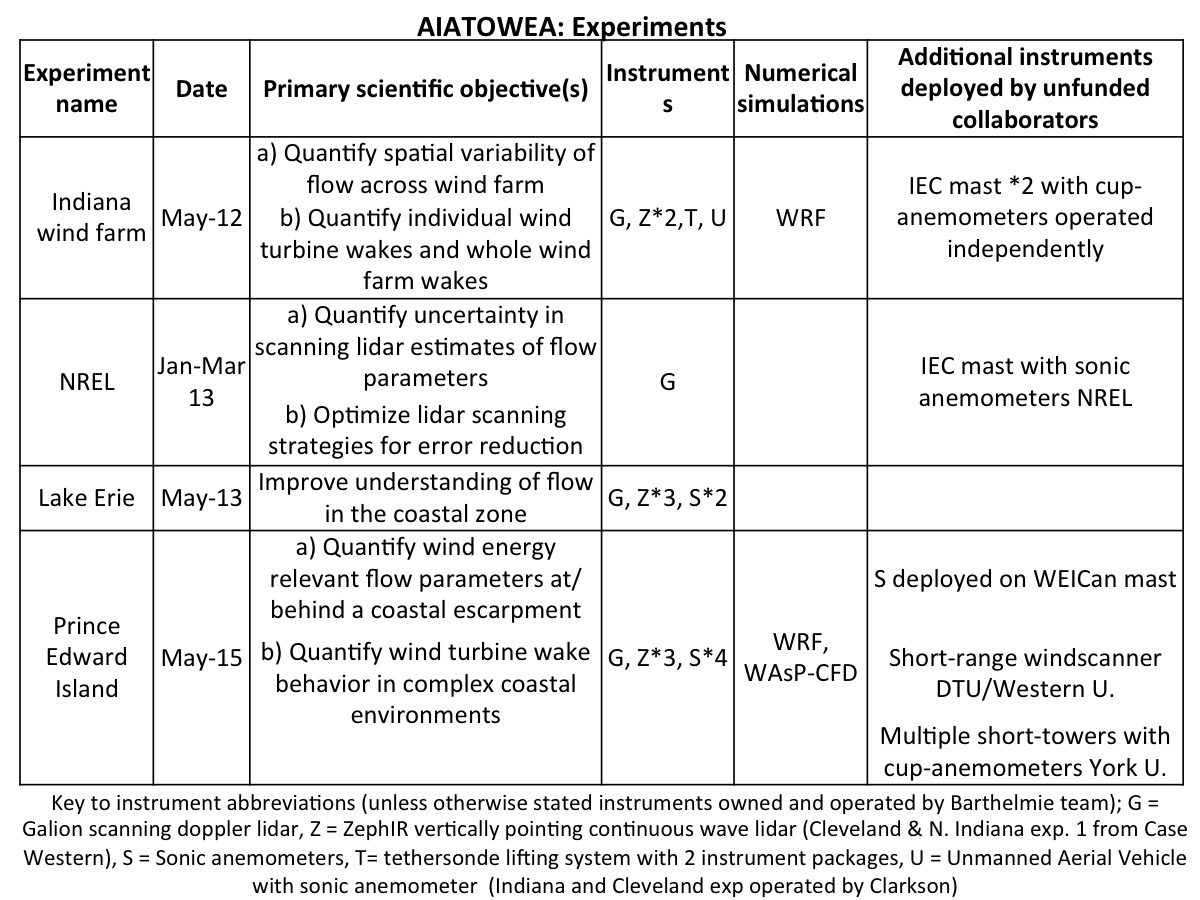
    Experiment #1: A large wind farm in Indiana (May 2012)

    This experiment was conducted at a large wind farm in the Midwest and had two primary research objectives; a) Quantify spatial variability of flow across wind farm b) Quantify individual wind turbine wakes and whole wind farm wakes. Experiment description

    Experiment #2: NREL (Jan-March 2013).

    The experiment was conducted at NREL and had two primary objectives: a) Quantify uncertainty in scanning lidar estimates of flow parameters b) Optimize lidar scanning strategies for error reduction. Experiment description

    Experiment #3: Coastal zone of Lake Erie (May 2013)

    This experiment focused on high quality measurements from lidar and data integration across a range of temporal and spatial scales to quantify the flow in the coastal zone in 3D. Experiment description

    Experiment #4: A wind farm at a coastal escarpment: PEIWEE (May 2015)

    Our two primary objectives were to; a) Quantify wind energy relevant flow parameters at/behind a coastal escarpment b) Quantify wind turbine wake behavior in complex coastal environments. The Cornell team also had a secondary objective focussed error quantification and reduction for lidar retrieval of wind speeds (both mean and higher moments - specifically variance). Experiment description

    Back to top

    Publications and presentations

    Best practice report

  • Barthelmie, R.J., Wang, H.., Doubrawa, P. and Pryor, S.C. 2016: Best practise for measuring wind speeds and turbulence offshore through in-situ and remote sensing technologies. Report to Department of Energy. DE- EE0005379. 7 July 2016. 47 pp. http://doi.org/10.7298/X4QV3JGF.
  • Journal articles

    Note we respect copyright and distribution rules. Where the journals provide free access please click on the link provided otherwise the articles you want may be accessible through your institutions library or as a last resort email me for a copy (rb737@cornell.edu)

  • Barthelmie, R.J. and Pryor, S.C. 2018: The impact of wind direction yaw angle on cliff flows. Wind Energy, 21, 1254–1265.

  • Sovacool, B, Enevoldsen, P, Koch, C. and Barthelmie, R.J. 2017: Cost performance and risk in the construction of offshore and onshore wind farms, Wind Energy, 20, 891–908

  • Doubrawa, P., Barthelmie, R.J. and Churchfield, M. 2017: A stochastic wake model based on new metrics for wake characterization, Wind Energy, 20, 449–463

  • Wang, H., Barthelmie, R.J., Doubrawa, P. and Pryor, S.C. 2016: Errors in radial velocity variance from Doppler wind lidar, Atmospheric Measurement Techniques, 9, 4123-4139. doi:10.5194/amt-9-4123-2016

  • Barthelmie, R.J., Doubrawa, P. Wang, H., Giroux, G., Pryor, S.C. 2016: Effects of an escarpment on flow parameters of relevance to wind turbines, Wind Energy, 19, 2271-2286

  • Doubrawa, P., R. J. Barthelmie, H. Wang, S. C. Pryor, and M. Churchfield, 2016: Wind turbine wake characterization from temporally disjunct 3-D measurements. Remote Sensing, 8, 939; doi:10.3390/rs8110939

  • Wang, H., Barthelmie, R.J., Pryor, S.C. and Brown, G.: 2016 Lidar arc scan uncertainty reduction through scanning geometry optimization, Atmospheric Measurement Techniques, 9, 1653–1669 doi: amt-9-1653-2016

  • Wang, H., Barthelmie R.J., Clifton, A. and Pryor S.C. 2015: Wind measurements from arc scans with doppler wind lidar, Journal of Atmospheric and Oceanic Technology, 32, 2024-2040, doi: 0.1175/jtech-d-14-00059.1.

  • Doubrawa, P., Barthelmie, R.J. Hasager, C.B., Badger, M., Karagali, I. and Pryor, S.C. 2015: Satellite winds as a tool for offshore wind energy resource assessment: The Great Lakes Wind Atlas, Remote Sensing of the Environment, 168, 349-359.

  • Barthelmie R.J. and Pryor S.C. 2014: The potential contribution of wind energy to climate change mitigation. Nature Climate Change, 4, 684-688. doi:10.1038/NCLIMATE2269

  • Barthelmie, R.J., Crippa, P., Wang, H., Smith, C.M., Krishnamurthy, R., Choukulkar, A., Calhoun, R., Valyou, D., Marzocca, P., Matthiesen, D., Brown, G. and Pryor, S.C. 2014: 3D wind and turbulence characteristics of the atmospheric boundary-layer. Bulletin of the American Meteorological Society, 95, 743–756.

  • Smith, C.M., Barthelmie, R.J. and Pryor, S.C. 2013: In situ observations of the influence of a large onshore wind farm on near-surface temperature, turbulence and wind speed profiles. Environmental Research Letters, 8, 034006

  • Wang, H., Barthelmie, R.J., Pryor, S.C. and H.G. Kim 2013: A new turbulence model for offshore wind turbine standards, Wind Energy, 17, 1587-1604.

  • Barthelmie, R.J. and Pryor, S.C. 2013: Wake model evaluation using data from the Virtual Wakes Laboratory, Applied Energy, 104, 834-844. doi 10.1016/j.apenergy.2012.12.013.

  • Barthelmie, R.J., Hansen, K.S. and Pryor, S.C. 2013: Meteorological controls on wind turbine wakes, Marine Energy and Environments. Invited Paper. Special Issue Proceedings of the Institute Electrical and Electronics Engineers, 101(4), 1010-1019.

  • Conference papers/presentations

  • Doubrawa, P., Barthelmie, R.J., Wang, H., Churchfield, M.J. 2016: Contributions of the Stochastic Shape Wake Model to Predictions of Aerodynamic Loads and Power under Single Wake Conditions, Science of Making Torque from Wind, Munich, 5-7 October 2016, 8 pp.

  • Barthelmie, R.J., Doubrawa, P., Wang, H. and Pryor, S.C. 2016: Defining wake characteristics from scanning and vertically pointing full-scale lidar measurements. Science of Making Torque from Wind, Munich, 5-7 October 2016, 8 pp.

  • Barthelmie, R.J. 2016: Quantifying wind turbine wakes with measurements, Affiliate Professor Inaugural lecture, August 3 2016, Danish Technical University, Risø campus.

  • Barthelmie, R.J. and Pryor, S.C. 2016: Flow and wakes in complex terrain: Results from the Prince Edward Island Experiment, European Academy of Wind Energy Ph.D. seminar, Invited speaker, May 24-25 2016, Danish Technical University, Lyngby.

  • Pryor, S.C. and Barthelmie, R.J. 2016: Can/will climate change impact the wind energy industry? ICRC-CORDEX 2016, Stockholm.

  • Doubrawa, P., Barthelmie, R.J., Wang, H., Pryor, S.C. and Churchfield, M.C. 2016: Wind Turbine Wake Characterization Metrics for Temporally Disjunct 3D Measurements. ISARS2016, 18th International Conference for the advancement of boundary-layer remote sensing, Varna, Bulgaria 6-9 June 2016.

  • Barthelmie, R.J., Wang, H., Doubrawa, P. and Pryor, S.C. 2016: Quantifying full-scale wakes with lidar measurements. ISARS2016, 18th International Conference for the advancement of boundary-layer remote sensing, Varna, Bulgaria 6-9 June 2016 (Poster).

  • Barthelmie, R.J., Wang, H., Doubrawa, P. and Pryor, S.C. 2016: Measuring wakes with lidar. Panel presentation 2016 Wind Energy Research Workshop, Lowell, MA on March 15-16 2016.

  • Barthelmie, R.J., Doubrawa, P., Wang, H., and Pryor, S.C. 2016: Observations and simulations of flow over an escarpment. 2016 Wind Energy Research Workshop, Lowell, MA on March 15-16 2016.

  • Barthelmie, R.J. 2016: Wind Energy Success: What Next? Invited keynote presentation to WindSTAR banquet, February 8 2016, University of Texas at Dallas.

  • Pryor, S.C. and Barthelmie, R.J. 2016: Can/will climate change impact the wind energy industry? Climatic Research Unit/Environmental Sciences Seminar, University of East Anglia, January 12 2016.

  • Hasager, C.B., Madsen, P.H., Giebel, G., Réthoré, P.E., Hansen, K.S., Badger, J., Peña, A., Volker, P., Badger, M., Karagali, I., Cutulusis, N., Maule, P., Schepers, G. Wiggelinkhuizen, E.J., Cantero, E., Waldl, I., Anaya-Lara, O., Attya, I., Svendsen, H., Palomares, A., Palma, J., Costa Gomes, V., Gottschall, J., Wolken-Möhlmann, G., Bastigkeit, G., Beck, H., Trujillo, J.J., Barthelmie, R.J., Sieros, G., Chaviaropoulos, T., Vincent, P., Husson, H., Prospathopoulos, J. 2015: Design tool for offshore wind farm cluster planning, European Wind Energy Conference, Paris, November 2015, 10pp.

  • Barthelmie, R.J., Wang, H., Doubrawa, P. and Pryor, S.C. 2015: An overview of the PEIWEE experiment 2015, WindTech 2015, Western University, Ontario, October 19-21 2015. (Invited keynote).

  • Wang, H., Barthelmie, R.J., Doubrawa, P. and Pryor, S.C. 2015: Uncertainty in Doppler Lidar Radial Velocity Variance Measurements, WindTech 2015, Western University, Ontario, October 19-21 2015.

  • Barthelmie, R.J., Wang, H., Doubrawa, P. and Pryor, S.C. 2015: Wind Turbine Wakes from Scanning Lidar, WindTech 2015, Western University, Ontario, October 19-21 2015.

  • Doubrawa, P., Wang, H., Pryor, S.C. and Barthelmie, R.J. 2015: WRF Simulations of a Pseudo Offshore Wind Farm: Validation Against Field Measurements and Evaluation of Wind Turbine Drag Parameterization, WindTech 2015, Western University, Ontario, October 19-21 2015.

  • Pryor, S.C. , Wang, H., Doubrawa, P. and Barthelmie, R.J. Measurements and Modeling of Wind Turbine Relevant Flow Parameters at an Escarpment During PEIWEE. WindTech 2015, Western University, Ontario, October 19-21 2015.

  • Barthelmie, R.J. 2015: Flow in complex terrain at height relevant to wind energy. Seminar in Atmospheric Science Graduate Field, Cornell University, 24 September 2015.

  • Barthelmie, R.J. 2015: Offshore wind energy; perspectives and prospects. Offshore Energy and Storage Symposium-3 July 2015, Edinburgh, UK.

  • Wang, H., Barthelmie, R.J., Pryor, S.C. and Brown, G. 2015: Uncertainty in lidar arc scan measurement, IEA Wind Topical Expert Meeting, #82 on Uncertainty Quantification of Wind Farm Flow Models, June 12 2015, Visby, Sweden.

  • Wang, H. and Barthelmie, R.J. 2015: Wind turbine wake detection with a single Doppler wind lidar, Wake Conference, Visby, Sweden, 9-10 June 2015. 9 pp. Journal of Physics: Conference Series 625 012017 doi:10.1088/1742-6596/625/1/012017.

  • Doubrawa, P., Barthelmie, R.J., Wang, H., Crippa, P. and Pryor, S.C., 2014: Impacts of boundary condition resolution on numerical simulations of coastal and offshore flow. American Wind Energy Association Offshore Conference, October 2014, Atlantic City (Poster).

  • Barthelmie, R.J., Pryor, S.C., Wang, H. and Doubrawa, P. 2014: Comparison of lidar measurements on the coast of Lake Erie. American Wind Energy Association Offshore Conference, October 2014, Atlantic City.

  • Doubrawa, P., Barthelmie, R.J., Badger, M., Karagali, I. and Hasager, C.B., 2014: Wind resource assessment of the Great Lakes from in situ and remote sensing observations. American Wind Energy Association Offshore Conference, October 2014, Atlantic City (Poster).

  • Barthelmie, R.J. and Pryor, S.C. 2014: Potential measurement strategy with lidar and sonics: Opportunity and issues, Microscale modeling of complex terrain flows, 25-26 September, University of Notre Dame.

  • Barthelmie, R.J. and Pryor, S.C. 2014: The potential of wind energy in climate change mitigation, Energy Engineering Seminar Series, September 2014, Cornell University.

  • Pryor, S.C. and Barthelmie, R.J. 2013: Can climate change impact wind energy? The science of making torque from wind conference, June 2014, Lyngby, Denmark (Poster).

  • Wang, H., Barthelmie, R.J., Crippa, P., Doubrawa Moreira, P. 2014: Observations of Coastal Atmospheric Boundary Layer over Lake Erie, The Science of Making Torque from Wind, Lyngby, June 2014. http://iopscience.iop.org/1742-6596/524/1/012117/pdf/1742-6596_524_1_012117.pdf

  • Barthelmie, R.J. and Pryor, S.C. 2013: Can wind energy impact climate change? The science of making torque from wind conference, June 2014, Lyngby, Denmark (Invited keynote).

  • Barthelmie, R.J. 2014: Wind energy 2030. Distinguished Faculty Research Lecture Indiana University (sole annual recipient), Indiana University, 2 April 2014.

  • Barthelmie, R.J. 2014: Everything you wanted to know about wind energy but were afraid to ask. Invited Keynote Presentation at the Crossroads Geology conference, Indiana University, March 28 2014.

  • Barthelmie, R.J., Doubrawa Moreira, P, Badger, M. and Hasager, C.B. 2014: Satellite and ground based observations integrated into a wind atlas for the Great Lakes, European Wind Energy Association Conference, Barcelona, March 2014 (Poster #170).

  • Barthelmie, R.J., Wang, H. and Pryor, S.C. 2014: Measuring full scale wind turbine wakes, European Wind Energy Association Conference, Barcelona, March 2014.

  • Barthelmie, R.J., Pryor, S.C. and Wang, H. 2013: 3D Wind: Quantifying wind and turbulence intensity. American Geophysical Union Fall Meeting, San Francisco, 9-13 December 2013 (Poster A13G-0309).

  • Wang, H., Barthelmie, R.J., Clifton, A., Capaldo, N. and Pryor, S.C. 2013: 3D wind: Developing and testing wind velocity retrieval algorithms for Doppler wind lidar #1798284. American Geophysical Union Fall Meeting, San Francisco, 9-13 December 2013 (Poster A13G-0304).

  • Barthelmie, R.J., Wang, H. and Pryor, S.C. 2013: Wind resource and wakes- results from the 3D wind experiment. European Offshore Wind Energy Conference and Exhibition, Frankfurt, November 2013.

  • Barthelmie, R.J., Pryor, S.C., Hansen, K.S. and Macguire, E. 2013: Wake merging at Lillgrund. European Offshore Wind Energy Conference and Exhibition, Frankfurt, November 2013.European Offshore Wind Energy Conference. Poster Prize (one of three non-student prizes).

  • Barthelmie, R.J.. 2013: Field experiment approaches to wind resource and wakes. WindEEE Scientific Symposium, 16 October 2013.

  • Barthelmie, R.J., Wang, H. and Pryor, S.C. 2013: Wind resource and wakes- results from the 3D wind experiment. Invited presentation at International Conference on Future Technologies for Wind Energy, 7-9 October 2013.

  • Valyou, D. Marzocca, P. Ceruti, A. “Design, performance and flight operation of an all composite unmanned aerial vehicle.” SAE 2013 AeroTech Congress & Exhibition, September 24-26, 2013, Montreal, Canada.

  • Ceruti, A. Valyou, D. Marzocca, P. “An integrated software environment for UAV mission operations.” SAE 2013 AeroTech Congress & Exhibition, September 24-26, 2013, Montreal, Canada.

  • Grappasonni, C. Arras, M. Coppotelli, J.T. Miller, D.N. Valyou, P. Marzocca, “System identification from GVTand taxing of an unmanned aerial vehicle,” SAE 2013 AeroTech Congress & Exhibition, September 24-26, 2013, Montreal, Canada.

  • Wang, H., Barthelmie, R.J., Pryor, S.C. and Kim, H.G. 2013: The relationship between wind speed and turbulence intensity for offshore wind turbine design, North American Wind Energy Academy Conference, Boulder, August 2013.

  • Barthelmie, R.J., Wang, H. and Pryor, S.C. 2013: Measurement of wind resource and wakes - results and lessons from the 3D wind experiment. Invited presentation at DONG, Fredericia, 8 July 2013.

  • Barthelmie, R.J. H. Wang and Pryor S.C. 2013: An Integrated Approach to Offshore Wind Energy Assessment: Great Lakes 3D Wind Experiment, X-Wi-Wa Workshop, DTU Risoe, Denmark, 11 June 2013.

  • Barthelmie, R.J. and Pryor, S.C. 2013: Wake model evaluation metrics and the virtual wakes laboratory. Proceedings of the 2013 International Conference on Aerodynamics of Offshore Wind Energy Systems and Wakes (ICOWES2013), Lyngby, June 2013, 173-181.

  • Pryor, S.C., Barthelmie, R.J., Crippa, P., Wang, H., Smith, C.M., Krishnamurthy, R., Calhoun, R., Valyou, D., Marzocca, P., Matthiesen, D., and Brown, G. 2013: Great Lakes 3D Wind Experiment. Proceedings of the 2013 International Conference on Aerodynamics of Offshore Wind Energy Systems and Wakes (ICOWES2013), Lyngby, June 2013, 132-137.

  • Barthelmie, R.J. 2013: Wind energy: Status and trends, IEEE Clean Energy, Case Western Reserve University, May 2013 (invited).

  • Barthelmie, R.J. and Pryor 2012: Wake model evaluation metrics. IEA Wakebench Annual Meeting, 9 November 2012, National Renewable Energy Laboratory, Colorado.

  • Barthelmie, R.J. 2012: Great Lakes 3D wind experiment. Part I. Calibration and testing. IEA Wakebench Annual Meeting, 8 November 2012, National Renewable Energy Laboratory, Colorado.

  • Smith, C.M., Barthelmie, R.J., Churchfield, M. and Moriarty, P. 2012: Complex wake merging phenomena in large offshore wind farms. AWEA Offshore, 9-11 October 2012, Virginia Beach.

  • Pryor, S.C., R.J. Barthelmie, H. Wang 2012: Extreme wind speeds in the coastal and offshore regions of the USA. AWEA Offshore, 9-11 October 2012, Virginia Beach. (Poster).

  • Barthelmie, R.J., S.C. Pryor, C.M. Smith, P. Crippa, H. Wang, Krishnamurthy, R., R. Calhoun, D. Valyou, Marzocca, P., Matthiesen, D. and N. Capaldo 2012: Great Lakes 3D wind experiment. Part I. Calibration and testing. AWEA Offshore 9-11 October 2012 Virginia Beach. (Poster).

  • Smith, C.M., Barthelmie, R.J., Churchfield, M. and Moriarty, P. 2012: Complex wake merging phenomena in large offshore wind farms. American Meteorological Society 20th Symposium on Boundary Layers and Turbulence, Boston, MA, August 2012.

  • Wang, H., Barthelmie, R.J. and Pryor, S.C. 2012: Suitability of offshore wind turbine design standards for America, Asia and Europe. European Wind Energy Conference and Exhibition, Copenhagen, April 2012. (Poster)

  • Barthelmie, R.J., Smith, C.M., Moriarty, P. and Churchfield, M. 2012: Wake merging in large offshore wind farms, European Wind Energy Conference and Exhibition, Copenhagen, April 2012. (Poster)

  • Barthelmie, R.J. and Pryor, S.C. 2012: Wake effects in offshore wind farms and impact on COE, Symposium on Wind Farms’ Underperformance and Partnerships. Texas Tech University, March 28-29 2102.

  • Barthelmie, R.J. 2012: Offshore wind energy: status and challenges, Invited seminar Texas Tech University Department of Mechanical Engineering, Lubbock, February 2012.

  • Barthelmie, R.J. 2012: New frontiers in wind energy research, Invited seminar Cornell University Department of Mechanical Engineering, Ithaca, February 2012.

  • Back to top

    Publicity

    Web sites

    Project overview based at Cornell University
    Professor Barthelmie's homepage (note faculty websites in Engineering at Cornell are blogs)
    Clarkson University blog regarding the UAV operations during the field experiments conducted under this project
    Wind Energy Institute of Canada where we conducted one of the project field experiments
    Other projects funded under this RFP

    Publicity/press releases and so on

    Our experiment on Prince Edward Island

    Poster describing first results from the PEIWEE in lay-person terms
    Press release regarding our field experiment at WEICAN on Price Edward Island

    Our new Great Lakes Wind Atlas

    Feature article in WINDTECH international
    Feature on the Wind Atlas from the Danish Technical University www site
    NCAR newsletter (Sept 2015)
    Midwest Energy news (Sept 2015)
    Cornell chronicle: September 2015
    The Great Lakes Wind Atlas we developed was also reported on ABC6 news 23 September 2015

    Project overview

    Research award

    UAV operation

    Clarkson University News: “Clarkson University Researchers Ready Unmanned Aerial Vehicle for DOE Wind Study” 02-01-2012
    sUAV News “Research Team from Clarkson University Develops UAV for US DOE Wind Study,” 02-03-2012
    OffshoreWIND.biz, “Clarkson University Research Team Gets Ready for DOE Wind Study” 02/02/2012
    Unmanned Systems Technologies, “UAV Developed for Wind Speed and Turbulence Analysis,” 06/08/2012
    Youtube video of Clarkson University UAV Maiden Flight Wide-Angle Camera, 05-16-2016

    Back to top

    Team

  • Professor Sara C. Pryor, Earth and Atmospheric Sciences
  • Professor Rebecca J. Barthelmie, Mechanical and Aerospace Engineering
  • Dr. Craig Smith, Post Doc (now at DRI)
  • Mr. John Wang (now Dr. Wang and now at Sgurr Energy)
  • Ms. Paula Doubrawa (now Dr. Doubrawa and now at NREL)
  • Mr. Steve Scott (technician)
  • Back to top

    Data

    Great Lakes Wind Atlas: A major product of our research was development of a new observationally constrined homogeneous wind atlas for the Great Lakes. You can download a zip file containing a netcdf format version of the atlas here . For details about how the atlas was produced is given in: Doubrawa, P., Barthelmie, R.J. Hasager, C.B., Badger, M., Karagali, I. and Pryor, S.C. 2015: Satellite winds as a tool for offshore wind energy resource assessment: The Great Lakes Wind Atlas, Remote Sensing of the Environment, 168, 349-359.
    Experimental data: Click on the links given above to find data from each of our experiments


    Back to top

    Disclaimer: “This website was prepared as an account of work sponsored by an agency of the United States Government. Neither the United States Government nor any agency thereof, nor any of their employees, makes any warranty, express or implied, or assumes any legal liability or responsibility for the accuracy, completeness, or usefulness of any information, apparatus, product, or process disclosed, or represents that its use would not infringe privately owned rights. Reference herein to any specific commercial product, process, or service by trade name, trademark, manufacturer, or otherwise does not necessarily constitute or imply its endorsement, recommendation, or favoring by the United States Government or any agency thereof. The views and opinions of authors expressed herein do not necessarily state or reflect those of the United States Government or any agency thereof.” Back to top